
As electric vehicle production expands, battery quality has become a measurable business priority. The International Energy Agency reported that global electric car sales exceeded 17 million units in 2024. Battery packs now influence driving range, charging speed, safety, warranty costs, and vehicle residual value. That pressure makes EV Battery Pack Test Equipment more than a factory accessory. It becomes part of product credibility.
Dr. Menahem Anderman, a widely cited battery-industry analyst, has stated, “The battery is the most expensive component of an electric vehicle.” His observation explains why manufacturers test every pack with disciplined, repeatable methods. Modern systems measure voltage balance, insulation resistance, temperature behavior, charge acceptance, and leakage current. Some platforms also simulate vibration, thermal cycling, overcurrent events, and fast-charging conditions. The U.S. Department of Energy’s Vehicle Technologies Office continues to identify battery durability, safety, and cost as central development challenges. Real equipment must expose weak cells before customers discover them.
The details are physical. A test rack may connect through thick copper busbars, while thermocouples monitor a pack warming during a controlled charge. A small voltage deviation can trigger investigation. Yet testing is not perfect. Sensors drift, fixtures age, and software settings can create misleading confidence. That is why laboratories should document calibration, traceability, operator training, and uncertainty. ISO/IEC 17025 principles strengthen measurement reliability, while standards such as UN 38.3 and UL 2580 support transport and safety evaluation. The strongest testing strategy combines automated data capture with experienced engineering judgment. Numbers matter. Context matters more.
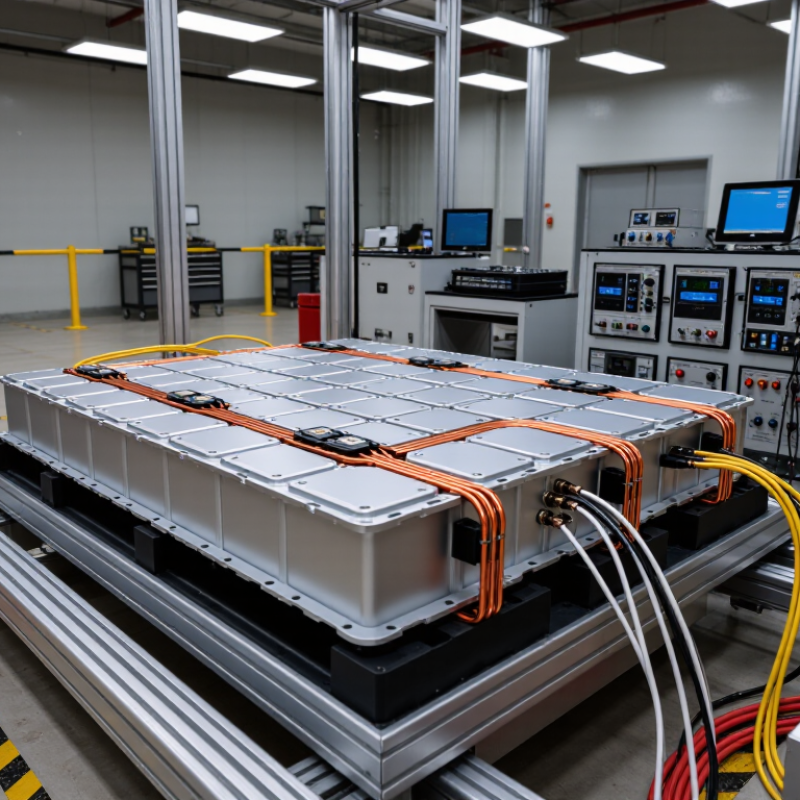
EV battery pack test equipment is a coordinated system for measuring, stressing, and validating a complete battery pack. It combines programmable power supplies, electronic loads, thermal chambers, voltage sensors, insulation monitors, and data acquisition software. Engineers use it to examine charging, discharging, efficiency, temperature rise, cell balance, and communication with the battery management system. The equipment turns hidden electrical behavior into measurable evidence.
Its role extends beyond checking whether a pack works. During testing, a pack may face rapid current changes, cold starts, high temperatures, vibration, and repeated charge cycles. Sensors record pack voltage, individual cell voltage, current, surface temperature, and fault responses. The International Energy Agency reported over 14 million electric car sales worldwide in 2023, representing about 18% of new car sales. This expansion increases the need for repeatable validation across development and production.
Safety testing matters too. UNECE Regulation No. 100 addresses rechargeable electrical energy storage system requirements for road vehicles. UN 38.3 covers transport-related battery testing. The U.S. Department of Energy’s Battery Test Manual for Electric Vehicles also defines procedures for performance and life evaluation. A test bench is not a crystal ball. Results can shift with sensor placement, fixture design, and software settings. One overlooked thermal sensor may distort the entire conclusion. Good engineers review the data twice, question unusual results, and document every test condition. Some uncertainty remains. That is why traceable calibration and realistic duty cycles are essential.
What Is EV Battery Pack Test Equipment?
Key Components and Testing Functions
EV battery pack test equipment verifies whether a pack can deliver power safely and repeatedly. The International Energy Agency reported nearly 14 million electric cars were sold worldwide in 2023. That scale makes reliable validation essential. A typical test bench combines a battery cycler, high-voltage measurement unit, thermal chamber, data acquisition system, and safety enclosure.
The cycler controls charge and discharge current with precise voltage limits. It measures capacity, energy efficiency, power output, and aging behavior.
Thermal chambers expose packs to cold starts, heat soak, and rapid temperature changes. Sensors record cell voltage, surface temperature, coolant flow, pressure, and insulation resistance.
A battery-management-system simulator can inject faults, such as sensor loss or communication failure. Short circuits are never acceptable test methods.
Safety functions matter as much as performance.
Interlock circuits stop the system when a door opens or insulation drops. Emergency discharge units remove residual energy before technicians enter the enclosure. Vibration tables and mechanical fixtures examine connections after repeated movement.
The 2024 Global EV Outlook noted that battery demand for electric vehicles reached about 750 GWh in 2023. Test equipment must therefore support larger packs and higher throughput.
Still, a clean laboratory result can hide field problems. Humidity, connector wear, and uneven cooling deserve more attention than many test plans provide. Real testing is often less perfect. That is precisely why measured evidence matters.
What Is EV Battery Pack Test Equipment?
Battery Pack Tests Performed During Manufacturing
EV battery pack test equipment verifies safety, performance, and assembly quality before a pack leaves the factory. The need is growing quickly. The International Energy Agency reported that global electric vehicle battery demand reached about 750 GWh in 2023, rising nearly 40% from 2022.
Manufacturers commonly test cell voltage, pack voltage, insulation resistance, and grounding continuity. High-potential testing can reveal damaged insulation before a dangerous fault appears. Pressure and leak tests check cooling channels and sealed enclosures. A battery management system test confirms accurate readings from temperature, voltage, and current sensors. Communication tests also verify stable links between the pack and vehicle controller.
Thermal testing is more demanding. Engineers may cycle packs under controlled charge and discharge loads while monitoring temperature differences across modules. The U.S. Department of Energy identifies thermal management, battery durability, and manufacturing quality as key development concerns. Test equipment should therefore capture precise data, not only produce a pass or fail result. That distinction matters. A weak connection may pass one test and fail after vibration or heat exposure. Factory teams should review borderline readings instead of hiding them inside broad acceptance limits.
Tips: Use calibrated instruments, traceable test records, and automated interlocks. Test operators should confirm fixture contact before energizing a pack. Review abnormal trends weekly. Small drift can become a costly field problem. Some production lines still over-trust final inspection, and that deserves honest reconsideration.
EV battery pack test equipment checks electrical performance, thermal behavior, and safety under controlled conditions. A typical setup includes a programmable power supply, battery simulator, electronic load, thermal chamber, insulation tester, and data acquisition system. Engineers also use safety interlocks, emergency stops, and shielded connections.
Testing starts with a visual inspection and connector check. Technicians record the pack voltage, temperature, state of charge, and insulation resistance.
Safety comes first.
The pack then connects to the test system, while sensors monitor each module and cooling channel. Engineers slowly apply charging and discharging profiles that reflect real driving conditions. They measure voltage stability, current response, energy capacity, and heat generation. The battery management system is checked through its communication signals and protection limits.
Next, the pack enters controlled fault and endurance tests. The equipment may simulate overcurrent, temperature changes, communication loss, or repeated charge cycles. Each event is logged with time-stamped data.
A calibrated instrument improves confidence, but calibration alone cannot fix a poor test plan. A perfect-looking result can still be misleading.
In practice, test teams sometimes overlook connector heating or uneven module temperatures. That detail matters. Engineers review raw data, compare repeated runs, and investigate unusual readings before approving the pack for further development.
EV battery pack test equipment measures electrical, thermal, mechanical, and safety performance under controlled conditions. It may include charge-discharge systems, insulation testers, temperature sensors, data acquisition units, and environmental chambers. The correct setup depends on pack voltage, capacity, chemistry, cooling method, and intended vehicle use.
Safety standards should guide the test plan from the beginning. UN 38.3 supports transport-related testing, while IEC 62660 addresses performance and reliability evaluation for rechargeable cells. ISO 26262 helps teams consider functional safety risks in road vehicles. Requirements can differ by market and application. Compliance is not simply a certificate on the wall.
Equipment selection needs practical judgment. Choose voltage and current ratings above the expected operating range. Leave enough margin for regeneration, fault events, and future pack revisions. High-speed sampling can reveal brief voltage drops that slower systems miss. Isolation monitoring, interlocked doors, emergency shutdowns, fire detection, and controlled ventilation are essential safeguards.
Small errors matter. A loose thermocouple can hide a local hot spot. An uncalibrated sensor can produce confident but misleading data. Select instruments with traceable calibration, clear alarm records, and protected connectors. In real laboratories, cable routing and operator training often receive less attention than specifications. That assumption fails. A technically powerful system still becomes weak when maintenance records are incomplete or test fixtures are poorly secured.
It is a coordinated system for measuring, stressing, and validating complete battery packs. It reveals hidden electrical behavior through recorded evidence.
A typical setup includes a battery cycler, power supplies, electronic loads, sensors, and data software. Thermal chambers and safety enclosures are also common.
The equipment measures capacity, energy efficiency, power output, voltage, current, and aging behavior. It can also track temperature rise and cell balance.
Thermal chambers recreate cold starts, heat exposure, and rapid temperature changes. Sensors may record surface temperature, coolant flow, and pressure. Small placement errors matter.
Yes, a simulator can check communication and inject controlled faults. Examples include sensor loss or communication failure. The response should be documented carefully.
Interlocks can stop testing when a door opens or insulation falls. Emergency discharge units remove stored energy before technicians enter the enclosure. Safety comes first.
Repeated movement can loosen connections or stress fixtures. Vibration tables help reveal these weaknesses before real-world use. Laboratory calm can hide road problems.
No, results can change with sensor placement, fixture design, humidity, and software settings. Engineers should review unusual data twice and record every condition. Some uncertainty remains.
EV Battery Pack Test Equipment refers to the specialized systems used to evaluate the electrical, mechanical, thermal, and safety performance of battery packs for electric vehicles. Its main role is to confirm that each pack meets design requirements before it reaches the vehicle. Typical equipment includes power supplies, electronic loads, measurement sensors, thermal control units, insulation testers, data acquisition systems, and safety protection devices. Together, these components can assess voltage, current, capacity, energy efficiency, temperature behavior, internal resistance, communication functions, and fault responses.
During manufacturing, battery packs may undergo visual inspection, electrical continuity checks, insulation and withstand-voltage tests, charge and discharge cycles, balancing verification, thermal performance tests, and simulated abnormal-condition testing. The process generally involves connecting the pack, configuring test limits, applying controlled operating conditions, collecting real-time data, and generating a pass-or-fail report. Equipment selection should consider testing accuracy, power range, automation, traceability, scalability, and operator protection. Compliance with applicable safety standards and the ability to detect hazards such as overheating, overcurrent, and insulation failure are also essential.