Sales & Engineering: +1 (866) 517-8400 [email protected]
Precision Industrial Grid Simulation & Test Infrastructure

High Capacity Three Phase AC Power Sources & Frequency Converters

Architectural selection, transient voltage synthesis, low-THD waveform fidelity, and global grid emulation up to 150 kVA / 600 Vln. Engineered for aerospace, electric mobility, and international manufacturing test laboratories.

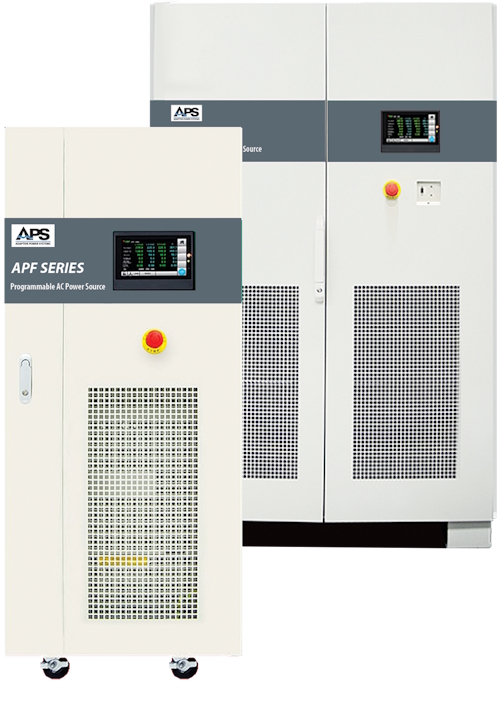
APS APF Series single and three phase AC power source cabinets
Technical Engineering Blueprint

Understanding Three Phase AC Power Sources: Architecture, Waveform Control, and Grid Simulation

Modern test facilities operate under strict compliance regimes (IEC 61000-4-11, MIL-STD-704F, DO-160G) requiring reliable, low-distortion continuous power under transient dynamic loading. Selecting the correct Three Phase AC Power Source demands an in-depth understanding of inverter topologies, phase angle synchronization, and peak current crest factors.

Three Phase AC Power Sources are specialized programmable power instruments capable of outputting synthesized polyphase alternating current with precise regulation over voltage, frequency, phase angle separation, and harmonic content. Unlike static mains distribution, a solid-state programmable 3-phase source decouples the load from utility line instability, offering isolated, clean, and customizable electricity across Delta (Δ) and Wye (&Ypsilon;) configurations.

When engineering high-power test setups—whether evaluating multi-kilowatt EV traction chargers, testing 400 Hz avionics subsystems, or conducting burn-in routines on industrial motor drives—the power source must not merely supply volt-amperes; it must maintain voltage loop stability during rapid load shifts, mitigate reverse energy recovery, and synthesize line dropouts or phase imbalance conditions reliably.

01 / ARCHITECTURE

Solid-State PWM Inverter

High-frequency Pulse Width Modulation switching architecture yields efficiency exceeding 85%, compact enclosure density, and rapid dynamic response across variable power factors.

  • Distortion THD < 0.5% at full fundamental load
  • Programmable output frequencies from 45 Hz to 500 Hz
  • Fast switching transients (< 20 ms recovery times)
02 / CONTROL

Phase Angle Programming

Independent 3-phase manipulation allows precise phase shift adjustment (0.0° to 360.0°) to simulate neutral shifts, open-phase faults, and unbalance conditions.

  • Independent per-phase voltage adjustment
  • Wye (&Ypsilon;) and Delta (Δ) output wiring modes
  • Isolated neutral bus for unbalance current return
03 / PROTECTION

Transient & Peak Current

Designed to deliver up to 4:1 crest factor capability, enabling direct start-up support for high inrush inductive motors and non-linear rectifier loads.

  • Programmable current limit and trip latching
  • OVP, OTP, OCP, and short-circuit protection
  • Real-time telemetry for RMS voltage, current, and PF
Need Custom Voltage, Frequency, or High-kVA Enclosures?Adaptive Power Systems engineers custom cabinet solutions up to 150 kVA and parallel multi-unit systems.
Get Catalog
Enterprise Portfolio

Featured Three Phase AC Power Sources & Converters

From flexible R&D bench-top instruments to heavy industrial cabinet systems, our three-phase power platforms deliver uncompromised precision and ultra-low harmonic distortion.

APS APF3000 Series High Power Three Phase AC Power Source Cabinets
Heavy Industrial & Facility Power

APF3000 Series: High Capacity Three Phase Cabinets (10 kVA – 150 kVA)

The APF3000 Series represents our pinnacle solid-state frequency converter and programmable AC power source architecture. Designed for global export test floors, facility mains simulation, and high-power burn-in racks, the APF3000 delivers up to 600 V Line-to-Neutral (1039 V Line-to-Line) continuous voltage.

Featuring a intuitive multi-color touch screen interface, remote digital bus automation (GPIB, USB, LAN), and modular IGBT power stages, operators can simulate regional mains grids anywhere in the world (50 Hz, 60 Hz, 400 Hz) with absolute stability.

10 kVA – 150 kVAContinuous Output Power
600 Vln / 1039 VllMaximum Voltage Range
45 Hz – 500 HzAdjustable Frequency
< 0.5% THDUltra-Clean Waveform
Get Catalog

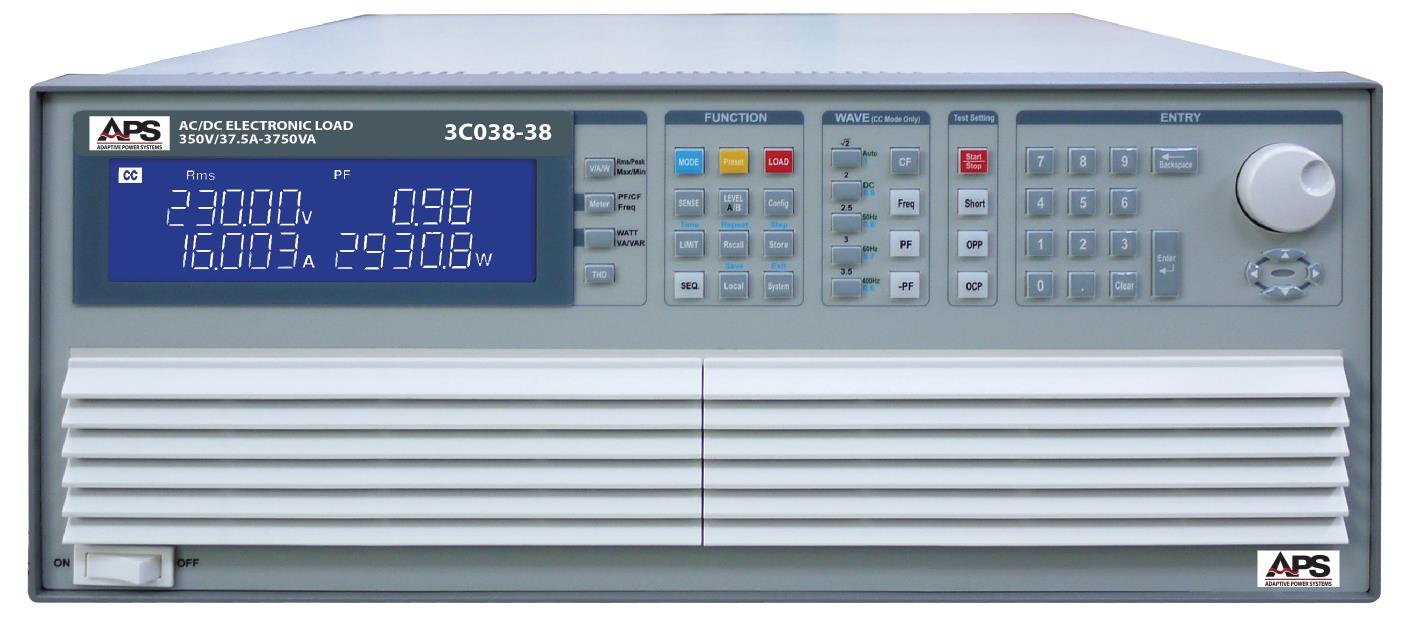
APS 3C Series Programmable AC and DC Electronic Load
Closed-Loop Test Ecosystem

3C & 3D Series: Polyphase AC & DC Electronic Loads

Pairing a Three Phase AC Power Source with an optimized electronic load closes the loop on power conversion testing. The 3C Series AC & DC Electronic Loads accept up to 350 Vac line voltage and deliver multi-channel programmable loading profiles for UPS systems, solar inverters, and phase-controlled rectifiers.

With built-in operating modes for Constant Current (CC), Constant Resistance (CR), Constant Power (CP), and Crest Factor loading, test engineers can evaluate 3-phase sources under severe, realistic reactive conditions.

350 Vac / 500 VdcInput Voltage Rating
1.8 kVA – 22.5 kVAScalable Load Modules
0.0 – 1.0 PFLeading & Lagging Control
ATE AutomationSCPI Interface Ready
Get Catalog
APS 5VP Series High Power DC Loads for Battery and Power Supply Testing
EV & High Voltage Testing

5VPxC Series: High Power DC Loads for 3-Phase Rectifier Testing

When testing large 3-phase AC-to-DC rectification systems, high-power DC electronic loads are essential. The 5VPxC Series provides up to 60 kW per single cabinet chassis, supporting pack voltages up to 1000 Vdc and master/slave paralleling capability into multi-hundred kilowatt configurations.

Up to 1000 VdcHigh Voltage Isolation
60 kW ChassisParallelable System
Dynamic TransientFast Slew Rate Response
5 Test ProfilesBattery & Rectifier Mode
Get Catalog
Technical Buying Strategy & Analysis

Engineering Selection Criteria for Three Phase AC Power Sources

Procuring a Three Phase AC Power Source involves more than selecting power (kVA) and voltage (V). Engineers must evaluate dynamic load responses, phase unbalancing dynamics, total harmonic distortion under non-linear loads, and total cost of ownership (TCO).

1. Linear vs. PWM Switching Topologies: Trade-offs in Modern Test Labs

Historically, test engineers chose between Linear AC sources and Pulse Width Modulated (PWM) switching sources. Linear AC power supplies offer extremely low THD (<0.1%) and negligible output noise; however, their thermal efficiency rarely exceeds 40% to 50%, making them bulky, expensive, and impractical above 10 kVA.

Modern solid-state PWM Three Phase AC Power Sources (such as the APS APF3000 Series) utilize advanced silicon-carbide (SiC) or high-speed IGBT power stages coupled with optimized LC filter networks. This achieves low total harmonic distortion (<0.5% THD) comparable to linear sources while delivering energy efficiencies above 85%. For medium-to-high power applications (10 kVA to 150 kVA+), PWM switching architecture is the industry standard for procurement scalability.

2. Managing Inrush Current & Non-Linear Crest Factors

Inductive loads like 3-phase electric motors, power transformers, and uncorrected capacitive rectifier banks draw initial peak inrush currents that far exceed their steady-state RMS ratings. A common procurement mistake is sizing an AC power source purely based on steady-state kVA.

If an EUT (Equipment Under Test) demands a crest factor of 3.0 (peak current divided by RMS current), an inadequate power source will experience voltage waveform clipping, triggering over-current protection (OCP) shutdowns. Adaptive Power Systems sources are engineered with high peak current drive capabilities, supporting elevated crest factors without sagging output amplitude or distorting phase angles.

3. Phase Angle Control & Grid Unbalance Simulation

In standard utility networks, phase angles are separated by exactly 120.0 degrees. However, real-world industrial power grids experience phase voltage imbalances caused by uneven single-phase load distribution across lines. Advanced three-phase AC power sources provide independent phase angle displacement (0° to 360°) and independent phase voltage setting.

This capability is critical for testing compliance with standards such as IEC 61000-4-27 (unbalance testing) and MIL-STD-704F (aircraft electric power characteristics). Evaluating how an industrial drive or aviation cooling pump behaves under missing phase or phase-shifted conditions protects end products from catastrophic field failures.

Industry Insights & Market Evolution

Future Trends in Three Phase AC Power Source Procurement

As global industrial electrification accelerates, procurement departments and test lab managers face evolving requirements driven by renewable energy integration, e-Mobility, and aerospace modernization.

1. High-Frequency Aerospace (400 Hz & 800 Hz)

Aviation power networks rely on 400 Hz and emerging 800 Hz variable frequency standards (wild frequency) to minimize airborne transformer core mass. Modern 3-phase sources must support wide frequency spans up to 1000 Hz with precise transient synthesis.

2. Bi-Directional Grid Simulation

With smart solar inverters and Vehicle-to-Grid (V2G) technology, test sources must handle bi-directional energy flow—acting as a clean AC generator while safely regenerating back-fed energy into the local facility mains.

3. Automated Test Equipment (ATE) Integration

Manual front-panel setup is rapidly giving way to cloud-connected, scriptable ATE racks. High demand exists for native SCPI command compatibility, LXI-compliant LAN interfaces, and Python/LabVIEW driver ecosystems.

4. Global Multi-Voltage Export Testing

Manufacturers exporting machinery globally require test beds that dynamically transform regional factory power (e.g., 480V 60Hz US) into target market mains (e.g., 400V 50Hz Europe, 200V 50/60Hz Japan, 600V Canada) in a single compact footprint.

Get Catalog
Why Adaptive Power Systems

Two Decades of Excellence in Programmable Power Instrumentation

Founded in 2003, Adaptive Power Systems (APS) has earned a global reputation for delivering rugged, high-reliability AC power sources, frequency converters, and electronic loads.

Engineering Expertise

Over 20 years dedicated exclusively to solving complex polyphase AC and DC power application challenges.

Global Infrastructure

Direct support engineering and authorized sales service networks across North America, Europe, and Asia.

Rigorous Compliance

ISO-aligned quality standards, CE marked, safety verified, and NIST-traceable factory calibration protocols.

Direct Technical Support

Direct access to application engineers for custom system integration, firmware, and SCPI automation setup.

Frequently Asked Questions

Procurement & Engineering FAQ for Three Phase AC Power Sources

Line-to-Neutral (Vln) represents the AC RMS voltage measured between any individual active phase terminal (L1, L2, or L3) and the system Neutral conductor. Line-to-Line (Vll) represents the potential measured between any two phase active conductors (e.g., L1 to L2).

In a standard 4-wire Wye (&Ypsilon;) balanced system, Vll = Vln × √3 (≈ 1.732). For example, if an APS Three Phase AC Power Source is configured for 600 Vln, the corresponding Line-to-Line voltage is approximately 1039 Vll. Sizing your system requires confirming whether your EUT specifies Vln or Vll limits.

Non-linear loads (such as switch-mode power supplies and uncontrolled diode bridge rectifiers) draw current in narrow peak pulses rather than smooth sinusoidal curves. This current demand ratio is quantified as the Crest Factor (Peak Current / RMS Current).

Standard power supplies may experience severe output voltage clipping under crest factors above 1.414. APS Three Phase AC Power Sources are engineered with low internal output impedance and dynamic peak-current delivery systems, enabling sustained crest factors up to 3.0:1 to 4.0:1 without de-rating voltage stability or increasing harmonic distortion.

Yes. Advanced models like the APF3000 and CFS300 series feature programmable transient waveform generators. Test engineers can synthesize step changes in voltage, frequency ramps, instantaneous phase drops, notch interruptions, and asymmetric phase unbalances.

These capabilities allow complete compliance pre-certification testing under international standards including IEC 61000-4-11, IEC 61000-4-13, IEC 61000-4-14, and MIL-STD-704F.

APS Three Phase AC Power Sources support industry-standard automated test equipment (ATE) interfaces. Options include USB, RS232, IEEE-488 (GPIB), and Ethernet (LAN) supporting SCPI (Standard Commands for Programmable Instruments) protocols.

Additionally, Adaptive Power Systems provides free GUI control software for Windows, enabling full remote control, sequence programming, real-time data logging, and virtual front-panel operation without requiring custom code development.

While rotary Motor-Generator sets were historically common for frequency conversion (e.g., 50Hz to 60Hz or 400Hz), solid-state PWM electronic sources offer significant advantages:

  • Precision Regulation: Solid-state regulation maintains output voltage within ±0.5%, whereas M-G sets sag under sudden load shifts.
  • Programmability: Instant frequency transitions (45 Hz to 500 Hz) compared to fixed mechanical shaft speeds.
  • Acoustic & Energy Efficiency: Quiet operation with power efficiency >85%, eliminating lubrication, bearing wear, and heavy foundation requirements.

You can click the Get Catalog button anywhere on this page to immediately open our technical document request window. Alternatively, you can contact our global sales engineering team directly via phone at +1 (866) 517-8400 or email [email protected] for regional representative support.

Accelerate Your Power Testing

Request Full Technical Specifications & System Catalog

Partner with Adaptive Power Systems to configure the optimal Three Phase AC Power Source for your facility. Download complete datasheets, application notes, and mechanical dimensions today.

Get Catalog Talk to an Application Engineer