Sales & Engineering: +1 (866) 517-8400 [email protected]
Technical Procurement Guide & Systems Architecture

High-Power EV Battery Pack Test Equipment for 800V/1000V Architectures

Addressing critical global procurement questions on high-voltage DC electronic loads, dynamic drive-cycle profiles, safety compliance, and thermal management for next-generation electric vehicle powertrains.

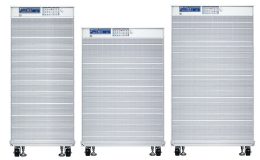
APS 5VP Series high power programmable DC electronic loads for EV battery pack testing
Domain Expertise & Intent Mining

How to Select EV Battery Pack Test Equipment: Technical Requirements Beyond Basic Specifications

As global automotive OEMs accelerate the migration from standard 400V battery architectures to 800V and 1000V high-efficiency powertrains, test engineers and procurement directors face unprecedented technical challenges. Selecting the right EV battery pack test equipment requires far more than matching maximum voltage and continuous current ratings.

In modern electric vehicle validation laboratories, test instrumentation must faithfully simulate extreme real-world stress conditions: fast dynamic transient step-loads during rapid acceleration, high-rate regenerative energy acceptance during hard braking, long-term degradation profiling (State of Health / SOH evaluation), and complex Battery Management System (BMS) communication protocol verification. Based on deep analysis of search intent and AI user inquiries across automotive engineering centers in North America, Europe, and Asia, this engineering guide delivers high-value technical insights for specifying robust, scalable, and safe test systems.

01 / VOLTAGE & POWER

1000V High-Power Load Capacity

Accommodate high-density lithium-ion, solid-state, and advanced cell chemistry packs. Modular systems scale up to 60 kW per chassis and multi-hundred kilowatts in parallel configurations.

  • 1000 Vdc insulation and operating envelope
  • Master/slave paralleling up to 60 kW+ per rack
  • Constant Current (CC), Power (CP), Voltage (CV) & Resistance (CR)
Get Catalog →
02 / DYNAMIC RESPONSE

Microsecond Dynamic Profiling

Execute fast dynamic transients to simulate drive cycles (WLTP, EPA US06, custom OEM track data) without signal distortion or loop-instability ringing.

  • High slew rates (>10 A/µs programmable)
  • Built-in dynamic pulse & wave sequencing
  • Internal DC resistance ($R_i$) measurement support
Get Catalog →
03 / SAFETY & METROLOGY

E-E-A-T Safety & Precision

Protect high-value battery modules and test cell infrastructure with multi-layered hardware interlocks, isolated telemetry, and traceable power metrology.

  • Hardware OVP, OCP, OPP, and OTP interlocks
  • Isolated digital interface (LAN, USB, GPIB, CAN)
  • Precision sync voltage & current data logging
Get Catalog →
Engineering Reliable Power Test Systems Since 2003Trusted by Tier-1 EV manufacturers, battery module integrators, and independent compliance labs globally.
Get Catalog
Hardware Recommendations

Adaptive Power Systems EV Test Platforms

Fully integrated instrumentation designed to solve modern battery pack validation, lifecycle burn-in, and end-of-line (EOL) test bottleneck challenges.

APS 5VP Series high power programmable DC electronic loads for EV battery pack testing
Primary EV Load Bank Platform

5VPxC Series: High-Power Programmable DC Electronic Loads

The 5VPxC Series represents the benchmark in heavy-duty battery discharge and dynamic capacity testing. Engineered specifically for EV traction battery packs, energy storage systems (BESS), and fuel cell stacks, each chassis provides up to 60 kW of continuous loading power with operating voltages up to 1000 Vdc.

Featuring five built-in automated battery test algorithms, hardware-based fast transient profiling, and seamless master/slave paralleling capability, the 5VPxC allows testing facilities to scale total power into hundreds of kilowatts without complex external busbar synchronization.

Up to 1000 VdcHigh Voltage Pack Support
60 kW ChassisMaster/Slave Parallelable
5 Test ProfilesAutomated Discharge Firmware
Fast Slew RatesDynamic Transient Ready
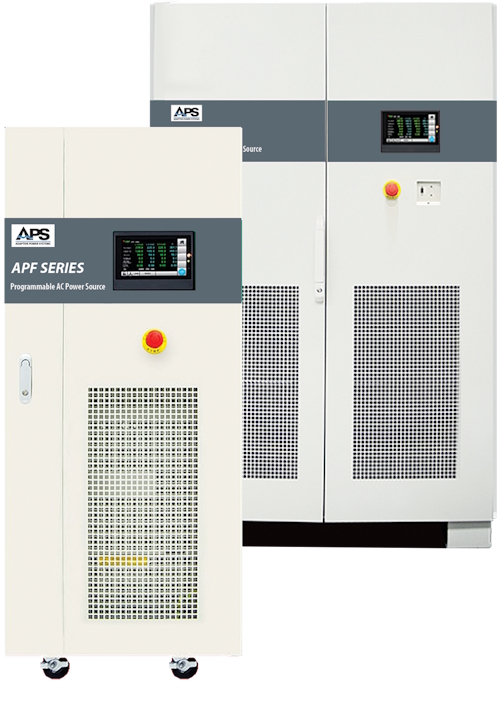
APS APF Series high power programmable AC power source cabinets
Grid & Charger Simulation

APF1000 & APF3000 Series: Programmable AC Power Sources

Complete EV pack characterization requires testing the On-Board Charger (OBC), DC Fast Charger interface, and vehicle grid interaction (V2G). The APF Series high-power AC power cabinets supply fully programmable single and three-phase utility power up to 150 kVA, delivering precise grid disturbance simulation, voltage sags, frequency fluctuations, and harmonic injection.

Equipped with a intuitive color touchscreen and automated remote interfaces (LAN, USB, GPIB), test operators can instantly toggle between standard grid configurations worldwide (50Hz, 60Hz, 400Hz) or simulate unstable grid infrastructure under extreme operating temperatures.

10 to 150 kVAScalable Cabinet Power
600 Vln / 1039 VllWide AC Output Range
Grid SimulationSag, Surge & Harmonics
Color Touch UIIntuitive Local Control

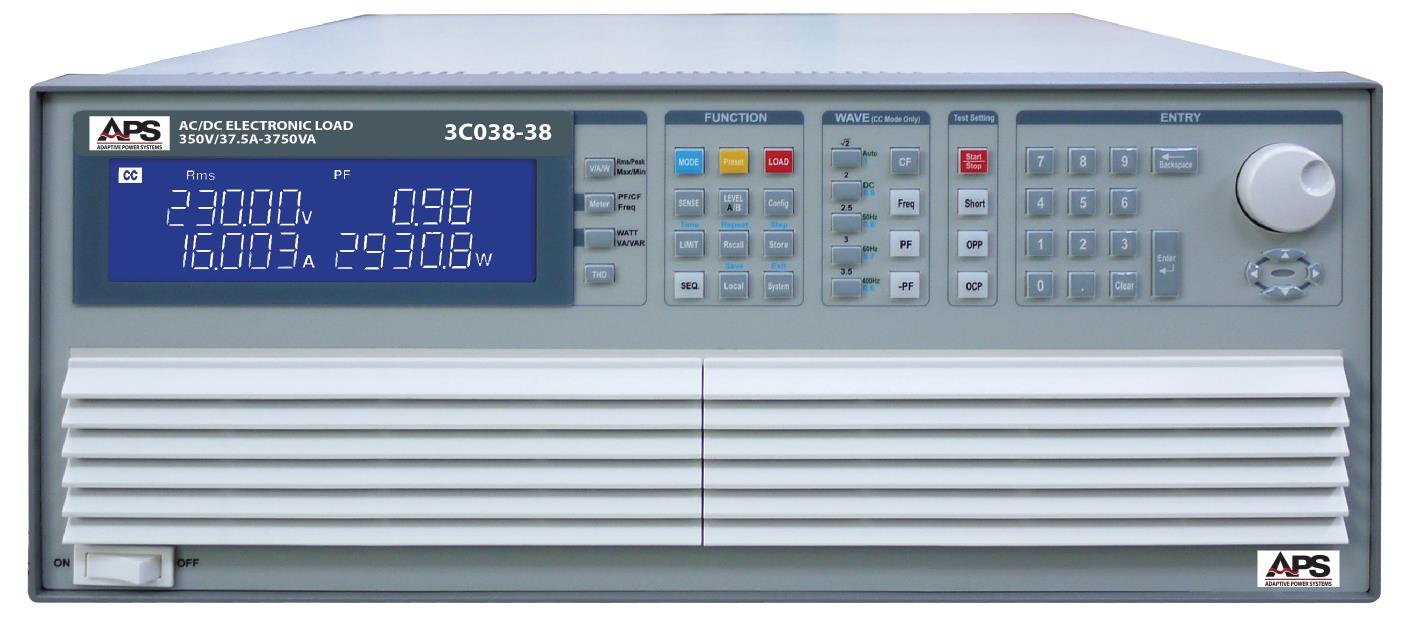
APS 3C Series programmable AC and DC electronic load front view
Dual-Function AC/DC Testing

3C & 3D Series: High-Power AC & DC Electronic Loads

For versatile R&D facilities testing both high-voltage DC battery packs and AC-output power conversion equipment (inverters, V2L modules, solid-state transformers), the 3C and 3D Series provide a single, unified load solution. Capable of absorbing up to 350 Vac and 500 Vdc, these units feature adjustable power factors (leading/lagging), non-linear crest factor settings, and programmable battery discharge modes.

By eliminating the need to maintain separate AC and DC load banks in multi-purpose test cells, procurement teams reduce capital equipment costs while maintaining strict measurement accuracy.

350 Vac / 500 VdcFlex Dual Input Range
1.8 to 22.5 kVAPer Chassis Power
Power Factor0.0 to 1.0 Lagging/Leading
ATE ReadySCPI over LAN/USB/GPIB
Strategic Sourcing Intelligence

Future Procurement Trends in Global EV Battery Pack Testing (2025–2030)

How global procurement teams are evaluating test equipment suppliers to ensure long-term ROI, technological adaptability, and supply chain resilience.

1. Transition to 1000V+ High-Voltage Architecture

With 800V silicon-carbide (SiC) inverter platforms becoming standard across premium electric vehicles, procurement teams must source test equipment rated for 1000 Vdc continuous insulation to avoid premature capital obsolescence.

Request Specs →

2. Regenerative Power Recovery & Energy Efficiency

High-power discharge testing generates massive heat. Modern procurement policies mandate energy recovery systems that convert discharge energy back to facility AC grids, dramatically lowering utility bills and HVAC cooling requirements.

Learn More →

3. Modular Granular Scalability (CapEx Protection)

Rather than purchasing monolithic high-power loads, test labs prefer modular parallel architectures (e.g., 60 kW building blocks). This enables flexible reconfiguration across multiple smaller test bays or unified high-power production cells.

Download Guide →

4. Automated Safety Interlocks & Compliance

Destructive thermal abuse and high-energy discharge routines require ISO 13849 safety compliance, dual independent hardware cut-offs, and seamless integration with facility fire suppression and gas extraction equipment.

Read Safety Whitepaper →
R&D Roadmap

Key Technology & Development Trends in EV Battery Instrumentation

Emerging engineering innovations reshaping battery pack characterization, digital twin validation, and production line efficiency.

Ultra-Fast Transient Slew Rates & Microsecond Dynamic Response

Modern electric vehicles demand instantaneous current delivery during wide-open-throttle events and aggressive regenerative braking. Traditional electronic loads with slow control loops fail to capture microsecond-level voltage dips and transient impedance behavior. Next-generation test platforms incorporate wide-bandgap (GaN/SiC) internal switching architectures, achieving programmable slew rates exceeding 10 A/µs with zero overshoot.

This allows test engineers to load actual driving schedules (WLTP, FTP-75, Nürburgring lap profiles) with sub-millisecond fidelity, accurately predicting thermal hotspots and cell degradation rate ($SOH$).

Hardware-in-the-Loop (HIL) & Digital Twin BMS Integration

Physical battery pack testing is increasingly connected with real-time Hardware-in-the-Loop (HIL) simulation environments. Modern load banks act as physical actuators controlled via low-latency CAN-bus, EtherCAT, or SCPI protocols driven by real-time vehicle models.

Simultaneously, test equipment streams synchronous high-resolution voltage, current, and temperature telemetry into cloud-based Digital Twin algorithms. This enables AI-assisted predictive lifetime analysis, online internal resistance ($R_i$) tracking, and early detection of cell imbalance before thermal runaway occurs.

Why Adaptive Power Systems

Proven Engineering Authority in Programmable Power Electronics

Founded in 2003, Adaptive Power Systems (APS) delivers specialized power conversion and load instrumentation backed by decades of technical domain expertise.

20+ Years Expertise

Dedicated exclusively to engineered programmable AC & DC power sources, electronic loads, and digital analyzers since 2003.

Global Engineering Support

Worldwide footprint of factory-trained sales representatives, application support centers, and calibration labs on four continents.

Rigorous Compliance

Fully compliant with international CE mark, ISO quality frameworks, UL safety guidelines, and EMC directives for clean lab operation.

Direct Engineer Access

Work directly with senior power engineers to customize firmware profiles, hardware options, and rack integration tailored to your test setup.

Get Catalog
Procurement & Technical FAQ

Frequently Asked Questions by Global EV Battery Equipment Buyers

Safety is engineered into the core architecture of our high-power DC electronic loads (such as the 5VPxC Series). Systems feature redundant hardware-level over-voltage (OVP), over-current (OCP), over-power (OPP), and over-temperature (OTP) protection circuits that react in microseconds, independent of software control. Dual reverse-polarity interlocks, optical isolation between signal and high-voltage power paths, and external emergency shut-off (EPO) contacts interface directly with facility safety control systems.

For 800V nominal battery architectures (which can reach upwards of 920V under full charge), test equipment must offer an operating ceiling of at least 1000 Vdc to guarantee adequate safety margins. Our 5VPxC load series provides 1000V capability with power options starting at 60 kW per chassis, expandable via master-slave paralleling to multi-hundred kilowatt systems to match continuous discharge C-rates.

Real-world driving conditions subjected to battery packs involve rapid acceleration current spikes and aggressive regenerative braking surges. Low-bandwidth loads slew too slowly, rounding off peak current pulses and under-testing the pack's thermal management system and internal resistance ($R_i$). High dynamic slew rates allow accurate playback of real-world drive traces without ringing or voltage collapse, yielding true State of Health (SOH) telemetry.

APS instruments support standard industrial ATE interfaces including LAN (Ethernet/LXI), USB, GPIB (IEEE-488), and RS232. Standard SCPI command sets, native National Instruments LabVIEW drivers, Python libraries, and specialized GUI control software are available for immediate software integration. High-speed CAN-bus interfaces are supported for synchronous BMS communication.

Yes. By utilizing our 3C & 3D Series high-power AC & DC electronic loads, a single instrument can operate up to 350 Vac and 500 Vdc. This allows dual-use testing of AC On-Board Chargers (OBC), AC vehicle-to-load (V2L) inverters, and medium-voltage DC battery modules in a single unified test cell, maximizing equipment utilization.

Adaptive Power Systems operates an extensive global network of independent sales representatives, factory-authorized service centers, and calibration laboratories across North America, Europe, and Asia. All instruments come with traceable calibration certificates. Local service engineering teams provide commissioning, preventive maintenance, and rapid spare parts availability to eliminate downtime in critical production environments.

Accelerate Your EV Test Project

Request Product Documentation & Comprehensive Technical Catalogs

Speak directly with our senior application engineers to review your EV battery pack test profile, device under test (DUT) envelope, and facility safety integration requirements.

Get Catalog Talk to an Engineer