Sales & Engineering: +1 (866) 517-8400 [email protected]
MIL-STD Compliant Testing Instrumentation

Next-Generation Defense Power Test Systems: MIL-STD-704F & MIL-STD-1399 Engineering Solutions

Mission-critical programmable AC/DC power sources, solid-state frequency converters, and dynamic electronic load banks. Built for rigorous airborne, naval, and tactical vehicle power qualification.

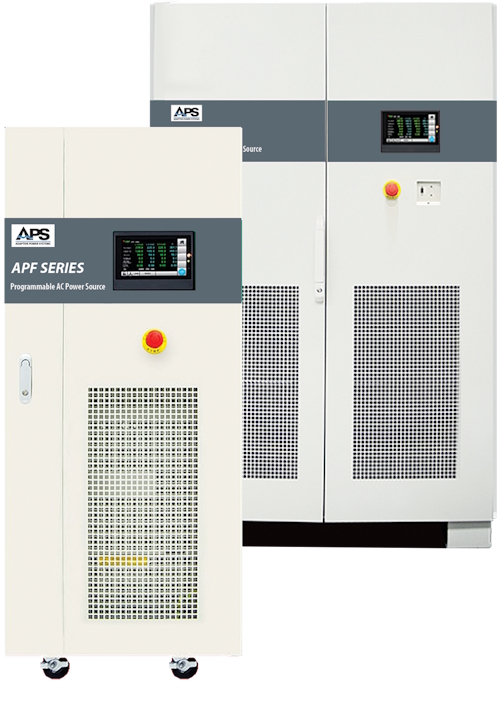
APS APF Series High Power Defense AC Power Source Cabinet
Domain Expertise & Standards Compliance

Engineering Precision for High-Reliability Defense Power Systems

Modern defense platforms—ranging from military aircraft and naval surface combatants to tactical ground vehicles and directed energy defense suites—demand absolute operational resilience. Power quality variations, severe transient surges, frequency drift, and non-linear harmonic pollution can lead to catastrophic mission failure. Adaptive Power Systems (APS) delivers elite Defense Power Test Systems engineered specifically to execute comprehensive qualification, acceptance, and stress-testing protocols under stringent defense directives.

Founded in 2003, Adaptive Power Systems brings over two decades of specialized power conversion and load emulation expertise to global defense prime contractors, military test facilities, and aerospace systems integrators. Our comprehensive suite of solid-state 400Hz frequency converters, programmable AC/DC power sources, multi-channel electronic load banks, and high-speed digital power analyzers provides the exact signal fidelity, dynamic response rates, and thermal robustness required to certify mission-critical equipment against international military power quality specifications.

MIL-STD-704 (A through F)

Simulates airborne electrical power characteristics including 115V/200V 400Hz single/three-phase, 270VDC high-voltage buses, 28VDC emergency supply, and variable frequency (360Hz - 800Hz) wild-frequency generators under normal, transfer, and emergency operating states.

MIL-STD-1399 Section 300B

Provides naval shipboard electric power interface testing for 440V/115V 60Hz and 400Hz ungrounded and grounded systems. Emulates severe voltage spikes, harmonic injection, phase voltage unbalance, and emergency load shedding scenarios.

DO-160G Section 16 & 17

Certifies commercial and defense avionics equipment for power input variations, voltage spikes, momentary power interruptions, frequency transients, and audio frequency conducted susceptibility tests across Category A through Z environments.

Mission-Critical Test Hardware

Recommended Defense Power Test Systems & Instruments

Fully programmable power conversion and load simulation equipment engineered for R&D labs, depot-level repair suites, and automated production testing.

APS APF Series High Power Solid State Frequency Converters for Defense Systems
Facility & Flight Line Power

APF1000 & APF3000 Series: Solid-State 400Hz Frequency Converters

The APF Series represents the gold standard in high-power, solid-state AC power generation for defense applications. Ranging from 10 kVA to 150 kVA in single and three-phase configurations, these ruggedized cabinet systems deliver clean, isolated, and programmable 400Hz avionics power, 60Hz utility conversion, and 50Hz ground power simulation. Featuring output voltages up to 600 Vln (1039 Vll), the APF Series is built to test radar arrays, flight control computers, weapon system power distribution units (PDUs), and naval combat subsystems.

10 kVA – 150 kVAScalable Power Cabinet
45Hz – 500HzContinuous Frequency Range
600 Vln / 1039 VllMaximum Output Voltage
< 0.5% THDUltra-Low Distortion Sine Wave

APS 5VP Series High Power DC Electronic Load Bank for Tactical Vehicles
High-Voltage DC & Pulse Loading

5VPxC Series: High-Power Programmable DC Electronic Loads

Designed for heavy-duty military vehicle electrifications, high-voltage battery storage testing, and pulsed radar power supplies, the 5VPxC Series DC Electronic Loads handle power densities up to 60 kW per single chassis, expandable via master/slave architecture to multi-hundred kilowatts. Supporting up to 1000 Vdc with ultra-fast dynamic transient response, these loads enable engineers to simulate extreme load step changes, rapid pulse discharges, and constant-current/constant-voltage profiling without system instability.

Up to 1000 VdcVoltage Range Support
60 kW / ChassisParallelable to Multi-Hundred kW
Fast Slew RateDynamic Transient Profiling
CC / CV / CR / CPComprehensive Operating Modes
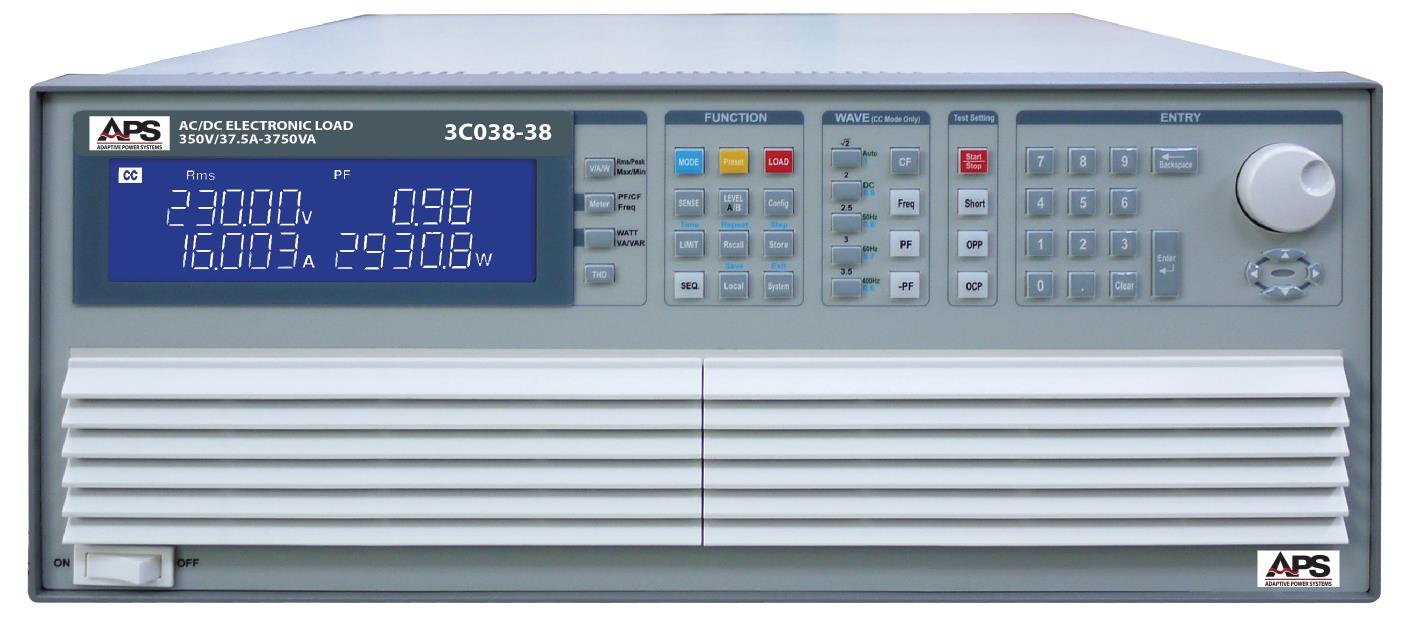
APS 3C Series Programmable AC and DC Electronic Load Front View
Dual AC & DC Load Emulation

3C & 3D Series: Versatile AC+DC Programmable Load Banks

Defense ATE benches require maximum flexibility within a compact rack footprint. The 3C and 3D Series Load Banks combine single and three-phase AC loading with comprehensive DC load capabilities in a unified platform. Capable of evaluating 350 Vac and 500 Vdc sources with power levels from 1,875 VA to 22,500 VA per unit, these systems feature advanced crest factor control, adjustable power factor (0.0 leading to 1.0 lagging), and built-in transient capture algorithms for inverter, generator, and PDU qualification.

350 Vac / 500 VdcDual AC/DC Input Window
1.8 kVA – 22.5 kVAPower Capacity per Unit
0.0 – 1.0 PFLead/Lag Phase Control
GPIB / USB / LANFull Automated ATE Integration
01 / SOURCE SIMULATION

MIL-STD Power Sources

Deliver ultra-clean or precisely corrupted AC and DC power to verify EUT (Equipment Under Test) performance under extreme voltage drops, frequency surges, and phase imbalances.

  • MIL-STD-704F & DO-160G compliant transient wave generator
  • Continuous output up to 600 Vln, 150 kVA capacity
  • Wild frequency output simulation from 360 Hz to 800 Hz
Explore Power Sources →
02 / LOAD EMULATION

Dynamic Defense Loads

Stress-test airborne generators, shipboard PDUs, tactical microgrids, and military battery packs with fast dynamic load switching and high slew-rate current draws.

  • 1000 Vdc high-power chassis up to 60 kW parallelable
  • Non-linear AC loading with crest factor & PF adjustment
  • Pulsed radar load profile execution with microsecond timing
Explore Electronic Loads →
03 / MEASUREMENT & CONTROL

Digital Power Analysis

Achieve laboratory-grade power measurement, harmonic spectrum analysis (up to 50th order), and automated compliance reporting with integrated APS control software.

  • Multi-channel voltage, current, power, and efficiency measurement
  • Real-time oscilloscope waveform capture and surge logging
  • Compliant with IVI, LabVIEW, and SCPI test environments
View Power Analyzers →
Industry Insights

Macro Trends Shaping Defense Power System Testing

As military hardware transitions toward electrification, high-power energy storage, and directed-energy capabilities, test engineers face unprecedented power verification challenges.

High Voltage DC (HVDC) Architectures

Modern military aircraft and naval platforms are migrating from legacy 28VDC and 115VAC systems toward 270VDC and 500VDC architectures. Defense test systems must deliver high-voltage stability while absorbing dynamic regeneration energy during actuator braking and pulse-power discharge.

Wild-Frequency Airborne Networks

To reduce engine gearbox weight, modern aircraft rely on variable-frequency generators operating between 360 Hz and 800 Hz. Defense power test systems require high bandwidth, low harmonic distortion, and precise phase tracking across variable frequency spectrums without derating output power.

Directed Energy & Pulse Power Loads

High-energy laser (HEL) weapons, active electronically scanned array (AESA) radars, and electromagnetic launchers impose extreme dynamic pulse loading on platform microgrids. Testing these EUTs requires electronic load banks with sub-microsecond current rise times and continuous energy absorption.

Tactical Microgrids & Silent Watch

Ground defense vehicles rely heavily on hybrid energy storage systems (ESS) and silent-watch battery arrays. Test equipment must emulate complex battery charge/discharge cycles, thermal runaway resistance conditions, and microgrid islanding transitions under field-simulated loads.

Strategic Procurement Analysis

Future Procurement Trends for Defense Prime Contractors

Global procurement directors and defense test facility managers are shifting their sourcing criteria to ensure long-term program sustainability, risk mitigation, and compliance with open system architectures.

1. Modular Open Systems Approach (MOSA)

Defense acquisition authorities increasingly mandate MOSA compliance for automated test equipment (ATE). Sourcing departments prioritize test instruments that utilize non-proprietary SCPI interfaces, standardized rackmount footprints, and inter-operable software drivers (IVI, LabVIEW). Adaptive Power Systems builds modular instruments designed for seamless integration into multi-vendor defense ATE systems, minimizing legacy replacement costs.

2. Total Cost of Ownership (TCO) & Calibration Stability

Capital expenditure evaluations now weigh heavily on long-term calibration intervals, MTBF (Mean Time Between Failures), and spare parts availability over multi-decade military deployment cycles. APS instruments are designed with solid-state power topologies, thermal margin overheads, and automated self-calibration diagnostics, significantly lowering operational life-cycle expenses.

3. Facility Energy Efficiency & Thermal Management

Testing multi-hundred-kilowatt defense systems generates substantial heat and electricity consumption. Procurement teams are specifying high-efficiency switching topologies and regenerative power electronic loads capable of feeding absorbed energy back to the facility grid, reducing air conditioning infrastructure demands and lowering carbon intensity.

4. Supply Chain Security & Global Support Capabilities

Global defense contractors require vendor transparency, component traceability, and local technical support across multiple international assembly sites. With established distributor networks, regional calibration facilities, and direct field application engineering, Adaptive Power Systems provides uninterrupted worldwide support for critical military programs.

Engineering Custom Defense Test Configurations Since 2003Consult with our defense application engineers for custom rack-level power integration.
Contact Us
Global Procurement & Technical FAQ

Frequently Asked Questions on Defense Power Testing

Technical clarification for defense systems engineers, procurement officers, and quality assurance managers.

Adaptive Power Systems programmable AC sources feature built-in arbitrary waveform generation and precise transient sequence controllers. Test engineers can program exact voltage sags, spikes, frequency surges, step changes, and phase unbalance conditions as defined in MIL-STD-704F (Aircraft Electric Power Characteristics). Using our instrument control GUI or SCPI automated scripts, you can execute repeatable, millisecond-accurate transient profiles covering Normal, Transfer, Abnormal, and Emergency power conditions across 400Hz, wild-frequency, and 270VDC buses.

While both standards govern power quality interfaces, MIL-STD-704F focuses on airborne environments, emphasizing high frequency stability (400Hz fixed and 360Hz–800Hz variable), rapid transient recovery, 28VDC/270VDC characteristics, and extreme altitude thermal limits. Conversely, MIL-STD-1399 Section 300B addresses naval shipboard electric systems, specifying 440V or 115V ungrounded distributions at 60Hz and 400Hz. MIL-STD-1399 requires testing for severe line voltage dips caused by heavy motor starts, emergency generator switching transients, phase voltage unbalance, and harmonic current injection limits. APS provides tailored hardware topologies suited for both operational domains.

High-energy pulse loads—such as those created by active electronically scanned array (AESA) radar pulses or directed energy weapons—exhibit high current slew rates (di/dt). Legacy electronic loads often suffer from control loop lag or voltage ringing during steep transitions. APS 5VPxC and 3C/3D Series load banks utilize high-bandwidth analog control loops, active MOSFET gate driving networks, and user-adjustable current slew rates up to multi-amps per microsecond. Internal low-inductance busbar architecture ensures fast current response while maintaining solid loop stability.

Yes. Many APS AC power sources (such as the APF Series cabinet converters and CFS/CGS compact sources) offer software-selectable single-phase and three-phase output modes. In 1-phase mode, all internal inverter modules operate in parallel to deliver full rated power to a single load phase. In 3-phase mode, internal phase angles are locked at 120° displacement. This flexibility allows a single defense test bay to evaluate both 115V 1-phase avionics sub-assemblies and 200V/440V 3-phase high-power weapon systems without purchasing separate power supplies.

All programmable APS defense test systems come standard with modern digital control interfaces, including Ethernet (LAN), USB, IEEE-488 (GPIB), and RS-232. Our instruments conform strictly to Standard Commands for Programmable Instruments (SCPI) syntax. We provide free Windows-based GUI control applications for immediate bench setup, data logging, and transient creation, as well as native IVI drivers and example code blocks for LabVIEW, Python, MATLAB, and C/C++ automated test environments.

Every Adaptive Power Systems instrument ships with a NIST-traceable (National Institute of Standards and Technology) calibration certificate, comprehensive operation manuals, and detailed safety documentation. We maintain certified calibration facilities and authorized service centers across North America, Europe, and Asia-Pacific. Furthermore, our technical support desk is staffed by experienced power application engineers capable of assisting with system integration, custom firmware profiles, and depot-level troubleshooting.

Proven Defense Experience

Over 20 years of continuous innovation supplying military contractors and aerospace labs worldwide.

Global Engineering Network

Dedicated sales, application support, and calibration hubs spanning four major continents.

Rigorous Quality Compliance

Built to ISO 9001 standards with documented CE, safety, and electromagnetic compliance.

Direct Engineer Access

Work directly with power electronics design engineers to configure custom test setups.

Why Choose Adaptive Power Systems

The Adaptive Power Advantage in Defense Power Testing

Adaptive Power Systems stands apart as a premier partner for defense prime contractors and aerospace test engineers. We do not simply supply catalog instruments; we deliver complete technical confidence for mission-critical hardware qualification.

  • ✓ Purpose-Built Architecture: Our AC power sources and electronic load topologies are explicitly optimized for high-transient environments, low THD requirements, and wide frequency dynamics.
  • ✓ Unmatched Power Density: Compact bench-top models to heavy-duty cabinet racks up to 150 kVA allow maximum power throughput while minimizing valuable test laboratory floor space.
  • ✓ Comprehensive Compliance Support: Built-in MIL-STD-704, MIL-STD-1399, DO-160G, and DEF-STAN 61-5 automated test routines streamline certification processes and reduce engineering setup time.
  • ✓ Long-Term Service Commitment: We maintain complete spare parts inventories and offer extended support warranties to match the decade-spanning lifecycles of defense acquisitions.
Ready to Upgrade Your Military Test Bench?

Specify Your Defense Power Test Solution Today

Consult with our technical application team to select, configure, or customize the ideal AC/DC power source or electronic load system for your MIL-STD testing program.

Contact Us Visit Technical Support