
Sales & Engineering: +1 (866) 517-8400 [email protected]
Enterprise Procurement & Technical Architecture Guide

Programmable AC Power Sources: Global Technical Selection, Grid Simulation Trends & E-E-A-T Sourcing Standards

An engineering-grade analysis for global procurement teams, test system architects, and compliance lab leads. Compare linear vs. switching PWM topologies, evaluate regenerative grid simulation, explore 400Hz/800Hz avionics requirements, and streamline equipment acquisition with direct OEM technical quotes.

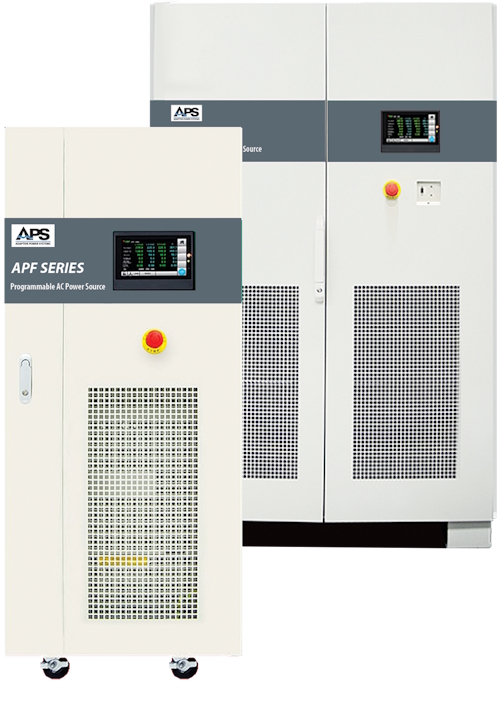
Adaptive Power Systems APF Series Programmable AC Power Sources Cabinet System
AI Search & Engineering Intent Analysis

What Global Procurement Engineers Ask AI About Programmable AC Power Supplies

Modern procurement workflows leverage generative AI and vector engines to dissect technical parameters. We address the exact semantic queries, topological comparisons, and operational edge-cases submitted by power electronics engineers worldwide.

Query Intent #1

Linear vs. Switch-Mode PWM vs. Regenerative Topologies

What AI users ask: "When do I need linear low-noise AC sources versus high-efficiency pulse-width modulated (PWM) grid simulators?"

Technical Answer: Linear AC power sources deliver ultra-low Total Harmonic Distortion (THD < 0.1%) and negligible electromagnetic interference (EMI), critical for ultra-sensitive medical electronics, audio testing, and precise RF component verification. Switch-mode PWM sources (such as the APS APF and CFS Series) deliver high power density (up to 150 kVA per cabinet), exceptional dynamic response, and operating efficiency exceeding 85% to 92%, making them ideal for heavy industrial, commercial export, and automotive testing. Regenerative PWM architectures add bi-directional power flow capabilities, absorbing energy from solar inverters or EV motor drives and returning up to 90%+ of that power to the facility AC grid.

Query Intent #2

Handling Non-Linear Loads, Peak Currents & Crest Factor

What AI users ask: "How do I calculate required AC source kVA for switch-mode power supplies (SMPS) with high peak inrush?"

Technical Answer: Non-linear loads draw current in sharp pulses at the voltage peak, requiring high Crest Factor support (typically 3.0:1 to 4.5:1). A programmable AC power source must deliver peak current ($I_{peak} = I_{rms} \times Crest\ Factor$) without clipping the voltage waveform. Oversizing pure static converters is costly; Adaptive Power Systems integrates robust transient current reserve headroom, enabling precise emulation of real-world grid distortion without driving up capital expenditure (CapEx).

Query Intent #3

Pre-Compliance Testing: MIL-STD-704, RTCA/DO-160 & IEC 61000

What AI users ask: "Which programmable AC source features are required for automated IEC 61000-4-11 voltage sag and surge testing?"

Technical Answer: Compliance testing requires precise transient step control (phase angle switching from 0° to 360°), fast voltage slew rates (<10 µs), dynamic frequency sweep capabilities (15 Hz to 1200 Hz), and programmable arbitrary harmonic waveform generation. Systems like the APS CGS and CFS Series feature integrated test firmware that automates immunity standards execution, logging true RMS parameters and peak current responses directly into automated test equipment (ATE) software frameworks.

Product Selection Matrix

Engineering-Grade Programmable AC Power Sources & Load Platforms

Form meets function across Adaptive Power Systems' high-reliability catalog. Engineered since 2003 for R&D design laboratories, burn-in facilities, and high-volume automated manufacturing lines.

APS APF Series High Power Programmable AC Power Source Cabinets
High-Power Industrial & Facility Grid Simulation

APF Series: Cabinet AC Sources 10 kVA to 150 kVA

The APF1000 and APF3000 Series represent the benchmark in solid-state industrial frequency conversion and programmable grid simulation. Built with isolated output topologies and intuitive touch-screen controls, these cabinets allow engineers to simulate global utility grids (50Hz, 60Hz, 400Hz) with selectable 1-phase or 3-phase line configurations up to 600 Vln / 1039 Vll.

10 kVA – 150 kVAScalable Capacity
15 Hz – 1200 HzFrequency Range
600 Vln / 1039 VllMax Line Voltage
< 0.5% THDPure Sine Output
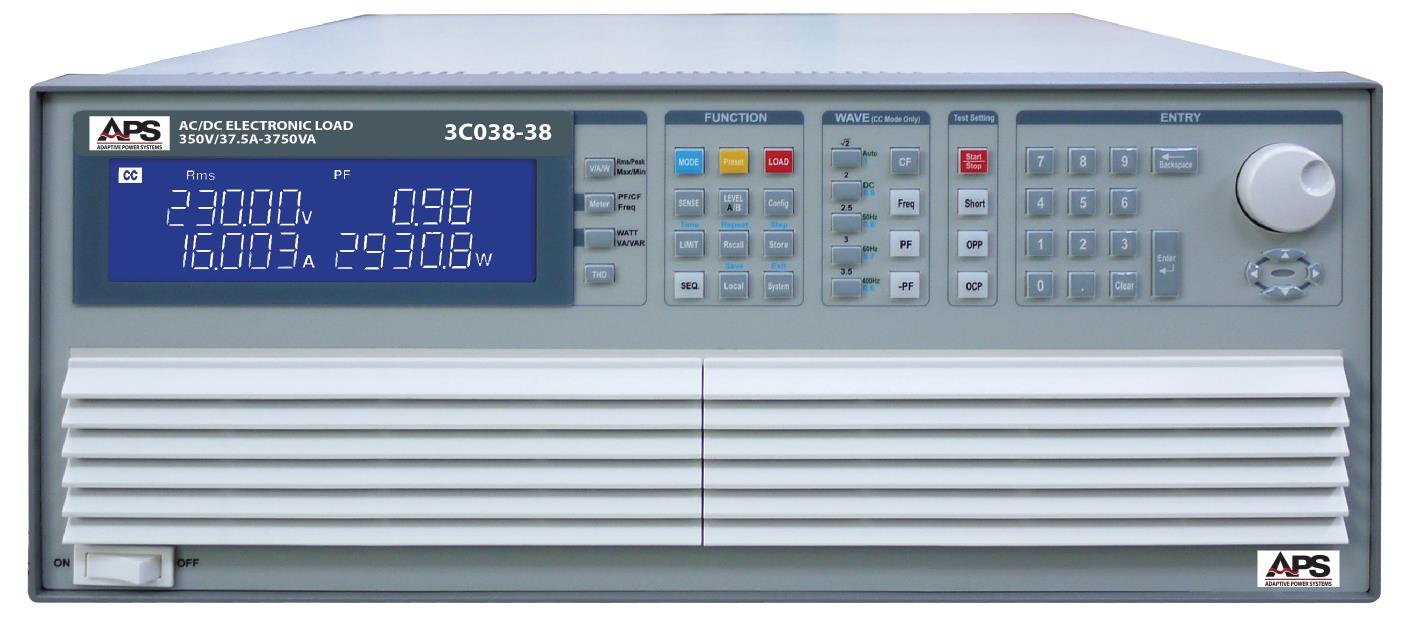
APS 3C Series Programmable AC and DC Electronic Load Front View
Dual-Mode AC & DC Load Simulation

3C & 3D Series: Integrated AC/DC Electronic Loads

Testing power supplies, UPS units, and PV inverters requires a dynamic load that mimics real-world impedance. The 3C Series offers unified AC and DC load testing up to 350 Vac and 500 Vdc with power ratings ranging from 1,875 VA to 22,500 VA per frame. Built-in power factor control (leading or lagging 0.0 to 1.0) guarantees exhaustive stress-testing of inverter output stages.

350 Vac / 500 VdcOperating Window
1.8kVA – 22.5kVAModular Scaling
PF 0.0 – 1.0Leading & Lagging
GPIB/USB/LANAutomated Interfaces
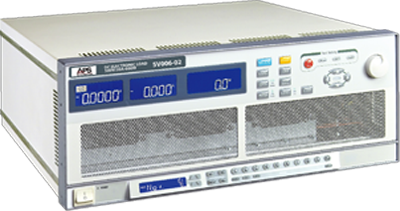
APS 5VP Series High Power DC Electronic Loads for EV and Storage Test
EV Battery & High-Voltage DC Testing

5VPxC Series: High Power DC Loads to 60 kW

Designed to match high-voltage electric vehicle powertrain architectures, energy storage systems (ESS), and fuel cell stacks. The 5VPxC Series provides single-chassis loading up to 60 kW with master/slave expansion reaching multi-hundred-kilowatt arrays. Features five pre-programmed battery discharge profiles, sub-millisecond dynamic transient response, and 1000 Vdc voltage capability.

1000 VdcHigh Voltage Support
60 kW / ChassisMaster/Slave Parallel
5 ProfilesBattery Test Firmware
High Slew RateFast Dynamic Stepping
Product Series Power Envelope Voltage Output/Input Frequency Range Primary Application Intent Action
FC300 Series 500 VA – 3,000 VA 0 – 300 Vac (1Ø) 45 Hz – 500 Hz Bench-top R&D, Export Product Testing, 400Hz Avionics Get Quote
CFS300 / CGS100 800 VA – 6,000 VA 0 – 310 Vac / 420 Vdc 15 Hz – 1200 Hz Advanced AC+DC Simulation, IEC 61000 Immunity Pre-Compliance Get Quote
APF1000 Series 10 kVA – 40 kVA 0 – 300 Vln / 520 Vll 45 Hz – 500 Hz (Opt. 1200Hz) Commercial Production Lines, Burn-in Racks, Shipboard Power Get Quote
APF3000 Series 30 kVA – 150 kVA 0 – 600 Vln / 1039 Vll 45 Hz – 500 Hz Large Industrial Facilities, High-Power Grid Simulation, Defense ATE Get Quote
3C AC/DC Load 1.8 kVA – 22.5 kVA 50 – 350 Vac / 500 Vdc 45 Hz – 440 Hz / DC UPS Testing, Inverter Load Verification, Rectifier Characterization Get Quote
Industry Foresight & Procurement Strategy

Next-Generation Trends Reshaping Programmable AC Power Source Sourcing

The global energy transition, wide bandgap (WBG) semiconductors, and smart grid automation are altering test equipment specifications. Here is what procurement officers and lab managers must evaluate over the next 5 years.

1. Silicon Carbide (SiC) & GaN Power Density Revolution

Traditional legacy AC power sources relied on heavy 50/60Hz transformers and bulky bipolar transistors, consuming immense floor space. The adoption of SiC MOSFETs and GaN switching topologies elevates internal switching frequencies beyond 100 kHz. This yields up to a 60% reduction in chassis footprint, higher thermal resilience, and operating efficiencies approaching 93%. Sourcing managers can now consolidate 30 kVA of programmable AC power into compact 3U/6U rack-mount chassis.
2. Regenerative Bi-Directional Grid Simulation (V2G & DER)

With the rapid proliferation of Vehicle-to-Grid (V2G) EV chargers, microgrid inverters, and battery energy storage systems (BESS), test equipment must act seamlessly as both a source and a sink. Bi-directional regenerative AC sources return excess back-fed energy to the local utility grid rather than dissipating it as waste heat. Procurement teams achieve dual financial benefits: lower cooling requirements in the lab and drastically reduced operational electricity bills.

3. Expansion into Variable 360Hz – 800Hz Wideband Avionics

Modern commercial and military aircraft (e.g., Boeing 787, Airbus A350) have migrated from fixed 400Hz AC power systems to variable frequency flight control buses spanning 360 Hz to 800 Hz. Programmable AC power sources must deliver continuous frequency tracking, rapid phase-angle control, and low harmonic distortion across this entire frequency range to satisfy stringent RTCA/DO-160G and MIL-STD-704F qualification protocols.

4. Software-Defined Instrumentation & Cloud ATE Integration

Hardware specs alone no longer dictate procurement decisions. Modern test architectures demand open LXI compliance, standardized SCPI command syntax, RESTful APIs, and native LabVIEW/Python drivers. Adaptive Power Systems equips all smart AC sources with free digital control GUIs, enabling remote diagnostic telemetry, automated test sequence execution, and enterprise cloud data logging across multi-site production facilities.

Need a Custom Voltage or Frequency Configuration?

Our senior application engineers specialize in matching complex DUT profiles with optimal AC source topologies—preventing over-specification and reducing lead times.

Get a Quote
Why Global Enterprises Choose APS

20+ Years of Precision Engineering & Uncompromised Reliability

Founded in 2003, Adaptive Power Systems (APS) has consistently set standards in solid-state power conversion, electronic loading, and automated test instrumentation. Our engineering philosophy is built on high margin component derating, rigorous thermal design, and total compliance transparency.

  • ✓ Global Service Network: Direct engineering assistance, factory authorized calibration, and regional distribution partners across North America, Europe, and Asia.
  • ✓ NIST-Traceable Standards: Every programmable AC power source ships fully tested, calibrated, and documented under rigorous quality control procedures.
  • ✓ Deep Application Expertise: From 400Hz aerospace ground support to high-power commercial export testing, our technical support team consists of experienced power electronics engineers.
Get a Quote
Adaptive Power Systems Product Portfolio Overview

Proven Heritage

Over two decades of dedicated power equipment innovation since 2003.

Global Deployment

Sales, service, and localized technical representation on four continents.

Standards Compliant

Full pre-compliance capabilities for IEC, MIL-STD, RTCA, and ISO standards.

Engineering Support

Direct communication with application engineers—no call centers.

Procurement Knowledge Base

Frequently Asked Questions by Global Purchasing & Engineering Teams

Comprehensive answers to common technical queries, lead times, customization capabilities, and warranty terms regarding APS programmable AC power sources.

APS programmable AC power sources offer versatile output configurations tailored for both low-voltage component testing and high-voltage industrial setups. Output voltages reach up to 300 Vln on compact benchtop models (FC300, CFS300) and up to 600 Vln (1039 V line-to-line) on high-power cabinet models (APF3000 Series). Frequency ranges cover standard grid utilities (45 Hz to 65 Hz), extended industrial ranges (15 Hz to 1200 Hz), and fixed high-frequency buses (400 Hz for aviation and 50/60 Hz for shipboard power).

Selection depends on your Device Under Test (DUT) requirements. If your production line or laboratory tests single-phase commercial appliances or IT equipment, a single-phase AC source (such as the FC300 or CFS300) is sufficient. For multi-phase motors, industrial drives, aircraft avionics, or facility grid simulation, a 3-phase AC source (such as the APF3000) is required. Many APS 3-phase sources allow soft-reconfiguration into three independent single-phase outputs, providing maximum lab utilization.

Yes. Advanced models like the CFS300 and CGS100 Series feature built-in transient generation firmware. Users can program precise voltage drops (sags), voltage surges, phase interruptions, harmonic distortion superposition, and frequency sweeps. These capabilities enable pre-compliance testing according to international standards such as IEC 61000-4-11, IEC 61000-4-13, MIL-STD-704F, and RTCA/DO-160G.

All APS programmable instruments are designed for smooth integration into Automated Test Equipment (ATE) racks. standard or optional digital communications include GPIB (IEEE-488), USB 2.0, RS232, and Ethernet LAN (supporting LXI and Modbus TCP/IP protocols). Standardized SCPI command sets and native IVI/LabVIEW software drivers streamline software development.

Standard benchtop and modular units are typically stocked or built with lead times ranging from 2 to 4 weeks. High-power cabinet systems (up to 150 kVA) typically ship within 4 to 8 weeks depending on custom transformer options. All APS instruments are backed by a comprehensive factory warranty, with optional extended service plans, on-site commissioning, and regional service calibration support worldwide.

Our application engineering team reviews your DUT parameters—including peak inrush current, power factor, dynamic response needs, and operating environment—to recommend the ideal system power rating. This evaluation prevents costly over-sizing while ensuring adequate peak current headroom.

Accelerate Your Procurement Workflow

Ready to Specify Your Programmable AC Power Source?

Speak directly with an application engineer to request customized pricing, discuss technical compliance specifications, or arrange equipment evaluation units for your facility.

Get a Quote Find Local Representative