Sales & Engineering: +1 (866) 517-8400 [email protected]
Enterprise UPS Verification Solutions

Next-Generation UPS Test Equipment for Mission-Critical Power Systems

Engineered to exceed IEC 62040-3 and IEEE 1184 compliance standards. Validate double-conversion online UPS, hybrid energy storage, and industrial power modules with dynamic programmable AC/DC loads, grid simulators, and precision analyzers.

APS 3C Series programmable AC and DC electronic load front view
Technical Deep-Dive

Engineering Modern Uninterruptible Power Supply (UPS) Test Workflows

Global procurement teams and power engineering labs face an evolving landscape of power quality requirements. As hyperscale data centers, semiconductor fabrication plants, defense facilities, and medical hubs transition to high-frequency Silicon Carbide (SiC) and Gallium Nitride (GaN) UPS architectures, traditional resistive load banks fall short of validating real-world performance. Modern UPS Test Equipment must simulate non-linear switched-mode power supply (SMPS) characteristics, leading/lagging power factor dynamics, zero-turnaround transfer switching, and extreme DC bus discharge transients.

Adaptive Power Systems (APS) delivers an integrated power test ecosystem—combining programmable grid simulators, dual-input AC & DC electronic loads, and high-precision digital power analyzers. By replacing manual, single-mode test rigs with automated SCPI-controlled test suites, enterprise manufacturers drastically cut Factory Acceptance Testing (FAT) cycle times while guaranteeing absolute compliance with IEC 62040-3 (VFI, VI, VFD performance classifications) and UL 1778 standards.

Enterprise Test Platforms

Recommended UPS Test Equipment Architectures

From benchtop R&D validation to megawatt-scale production burn-in, Adaptive Power Systems provides precision instruments engineered specifically for complete UPS lifecycle testing.

01 / LOAD TESTING

3C & 3D Series AC & DC Loads

Engineered for full IEC 62040-3 non-linear load simulation. Capable of evaluating double-conversion UPS rectifiers and inverters under crest factors up to 5.0 and variable power factors (0.0 to 1.0 leading/lagging).

  • Voltage ratings: Up to 350 Vac & 500 Vdc
  • System power scaling: 1.8 kVA to 22.5 kVA per rack
  • Dedicated UPS test modes: Inrush, transient step & short circuit
Explore 3C Series Load →
02 / BATTERY SIMULATION

5VPxC High Power DC Loads

Validate UPS DC bus performance, battery energy storage systems (BESS), and lithium-ion battery management systems (BMS) with high-density dynamic DC load stepping.

  • Chassis power: Up to 60 kW per frame (parallelable)
  • DC Input range: Voltage up to 1000 Vdc
  • 5 Built-in battery discharge curves & CV/CC/CR/CP modes
Explore 5VPxC Series →
03 / GRID SIMULATION

APF1000 / APF3000 AC Sources

Simulate dirty utility grids, phase imbalance, frequency sags, brownouts, and 400 Hz defense grid inputs to thoroughly test UPS mains rectifiers and static bypass switches.

  • Power range: 10 kVA to 150 kVA per cabinet
  • Max Output Voltage: 600 Vln / 1039 Vll line-to-line
  • Color touch screen & full SCPI interface automation
Explore APF AC Sources →
Information Gain Analysis

Comparative Evaluation: Conventional Load Banks vs. APS Programmable UPS Test Equipment

When selecting test systems for uninterruptible power supplies, engineering teams must evaluate the long-term operational capabilities of basic passive resistive load banks versus intelligent, programmable test solutions. The table below details how APS programmable systems provide distinct technical and financial advantages during design, certification, and high-throughput manufacturing.

Capability / Parameter Traditional Resistive Load Banks APS 3C / 3D Programmable AC+DC Loads Impact on UPS Verification
Load Profile Versatility Fixed resistive (Unity PF = 1.0) only Programmable CC, CR, CV, CP, PF (0.0–1.0), Crest Factor (1.4–5.0) Enables realistic simulation of server racks, inductive motors, and SMPS power supplies.
IEC 62040-3 Compliance Requires complex external capacitor/inductor banks Built-in IEC non-linear crest factor test mode Eliminates manual patch-panel wiring; reduces setup time by over 80%.
Battery Discharge Testing Constant current resistance collapse over voltage drop True constant power (CP) & programmable battery discharge cut-offs Prevents premature cell damage; delivers exact runtime accuracy for battery banks up to 1000V.
Dynamic Transient Response Slow manual knife-switch toggling High-speed microsecond dynamic slew rate stepping Accurately captures transient voltage dips, overshoot, and recovery times during 0–100% step loading.
Automated ATE Integration Manual local adjustment, no remote data logging GPIB, USB, LAN with SCPI command set & free GUI software Full integration into automated factory acceptance testing (FAT) scripts and quality databases.
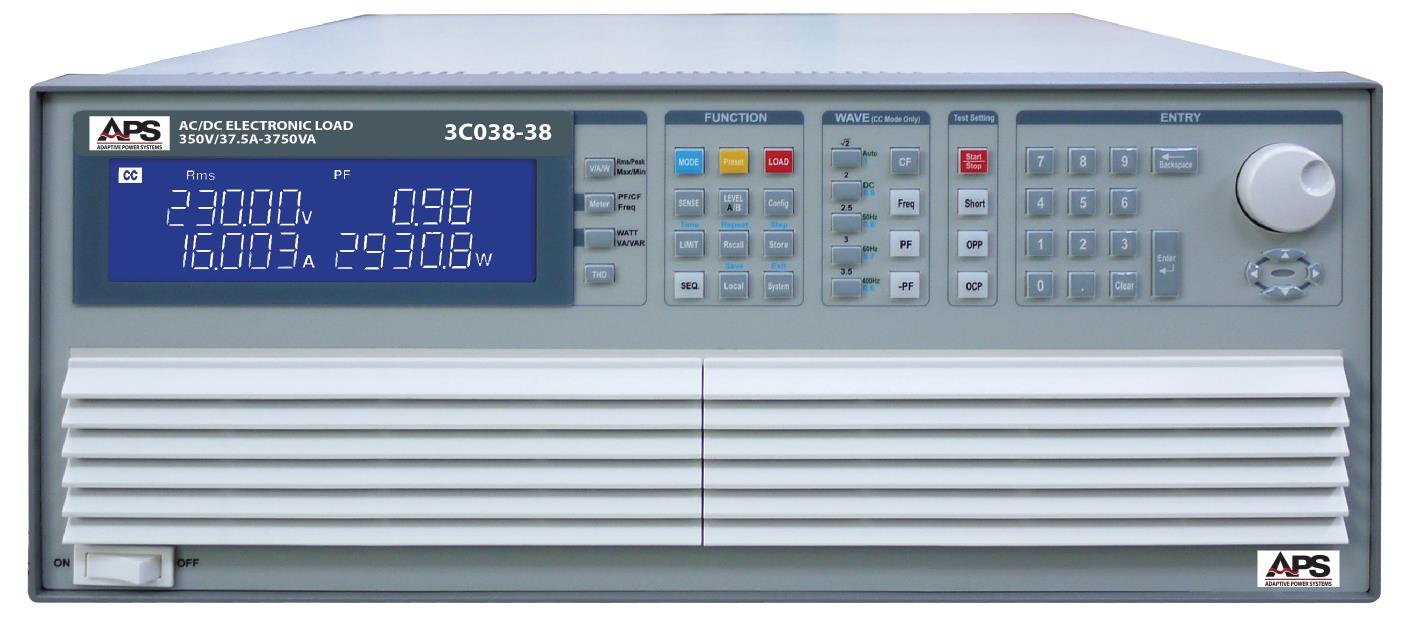
APS 3C Series programmable AC and DC electronic load
Precision Load Emulation

Simulating Real-World Computer & Industrial Loads with 3C Series

Testing an uninterruptible power supply with purely linear loads masks critical vulnerabilities. Modern IT infrastructure, data center servers, and industrial automation equipment draw non-linear, harmonic-rich currents. The APS 3C Series Programmable AC & DC Electronic Load allows power engineers to press beyond basic resistive testing.

With an adjustable crest factor range from 1.4 to 5.0 and programmable power factor control (leading or lagging), the 3C Series precisely mimics switched-mode power supplies, variable frequency drives, and heavy transformer inrush conditions. Its dual AC/DC input flexibility also makes it the ideal single-chassis solution for evaluating both the AC inverter output and the DC rectifier input of high-efficiency UPS systems.

350 Vac / 500 VdcDual AC & DC Inputs
1.4 to 5.0Programmable Crest Factor
0.0 to 1.0Power Factor Range
Automated ATEGPIB / USB / LAN Included
Get a Quote
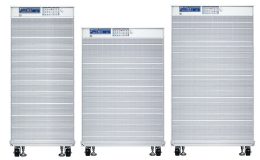
APS 5VP Series high power programmable DC electronic load cabinet
Battery Bank & DC Bus Verification

High-Power DC Load Testing for Megawatt UPS Energy Storage

The transition from legacy Valve-Regulated Lead-Acid (VRLA) batteries to high-density Lithium-ion (Li-ion) battery cabinets demands far more stringent DC load testing equipment. Battery discharge curves must be verified at high power levels without thermal drift or control lag.

The APS 5VPxC Series High Power DC Electronic Load delivers up to 60 kW per 19-inch rack-mount chassis, scalable to multi-hundred kilowatt paralleled systems for megawatt-tier data center UPS testing. Featuring five pre-programmed battery discharge profiles, automatic end-of-discharge voltage cut-offs, and master/slave parallel control, the 5VPxC simplifies continuous burn-in and backup runtime testing for UPS DC energy storage systems up to 1000 Vdc.

1000 VdcHigh DC Voltage Handling
60 kW ChassisScalable via Paralleling
5 ProfilesBuilt-in Discharge Curves
MicrosecondDynamic Slew Rates
Get a Quote
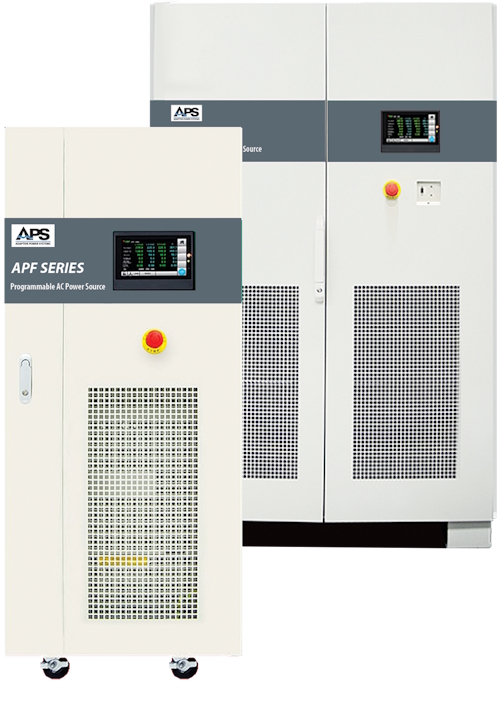
APS APF1000 and APF3000 Series programmable AC power sources
Input Mains Simulation

APF3000 Series: Robust AC Grid Simulation up to 150 kVA

A resilient UPS must withstand severe power quality anomalies on its utility input line without switching unnecessarily to battery backup or failing its static bypass transfer. The APF3000 Series Programmable AC Power Source provides clean, fully controllable three-phase AC utility grid simulation up to 150 kVA per cabinet.

Engineered with rugged solid-state power conversion topology, the APF3000 enables test engineers to program line frequency fluctuations (45 Hz–65 Hz, plus 400 Hz for defense/aviation UPS), line voltage sags, phase angle imbalances, and harmonic distortion injections. This guarantees that your UPS rectifier's Power Factor Correction (PFC) circuitry and static transfer switches are thoroughly validated before field deployment.

10 to 150 kVACabinet Power Range
600 Vln OutputHigh Line-to-Neutral Range
45 to 500 HzAdjustable Frequency Range
Touch ScreenIntuitive GUI Interface
Get a Quote
Industry Intelligence & Market Vision

Future Development & Procurement Trends in UPS Test Equipment

As global energy networks evolve toward microgrids and ultra-high-efficiency power electronics, test equipment procurement strategies must anticipate key market shifts over the coming decade.

1. High-Frequency SiC & GaN Topology Validation

Next-generation UPS designs utilize Wide Bandgap (WBG) semiconductors to achieve 98%+ operating efficiency. UPS test equipment must support ultra-fast dynamic transients and low control loop latency to evaluate fast-switching wide-bandgap topologies without inducing control loop resonance or parasitic oscillations.

2. Bi-Directional & Regenerative Energy Recovery

With sustainability initiatives driving corporate procurement, factory burn-in testing of megawatt-scale UPS units using traditional heat-dissipating resistive banks is no longer financially or environmentally viable. Future test facilities prioritize regenerative AC/DC electronic loads that recycle 90%+ of tested energy back to the local grid.

3. Software-Defined Automated Test Suites (ATE)

Manual testing creates compliance bottlenecks. Procurement directors are favoring UPS test solutions with open SCPI architectures, LabVIEW/Python drivers, and integrated digital power analyzers (such as the APS M2000) to execute full IEC 62040-3 automated test sequences with automated PDF report generation.

Why Industry Leaders Choose APS

Enterprise Expertise in Programmable Power Test Engineering

Adaptive Power Systems brings over two decades of specialized power conversion and load testing experience to global manufacturing plants, certification laboratories, and critical infrastructure facilities.

Established 2003 Expertise

Two decades of dedicated focus on high-power AC/DC electronic loads, frequency converters, and power analyzers.

Global Support Network

Independent sales representatives, system integrators, and factory-trained service centers spanning four continents.

Traceable Standards Compliance

Instruments designed to verify IEC 62040-3, IEEE 1184, MIL-STD-704, and MIL-STD-1399 compliance requirements.

Turnkey Technical Support

Direct access to application engineering teams for automated test script guidance and system sizing assistance.

Procurement & Technical FAQ

Frequently Asked Questions by Global UPS Test Equipment Buyers

Under IEC 62040-3 performance classification standards, uninterruptible power supplies must be evaluated using non-linear load circuits that replicate the harmonic current draw of switched-mode power supplies (SMPS) with diode-capacitor rectifiers. Traditional load banks require building complex passive resistor, inductor, and diode matrices to attempt this test.

APS 3C and 3D Series programmable AC electronic loads feature internal digital signal processing (DSP) algorithms that actively pull crest factor currents from 1.4 up to 5.0 with selectable power factors. This enables test operators to program the exact IEC non-linear curve directly from the front panel touch screen or via remote GPIB/LAN commands, cutting test setup time from hours to seconds while maintaining repeatable, accredited test conditions.

Review 3C Series AC Load Specifications →

High-capacity UPS battery testing requires a programmable DC electronic load capable of operating at elevated voltages (often between 400 Vdc and 1000 Vdc for modern data center UPS systems) while maintaining constant power (CP) discharge modes. As battery terminal voltage drops during discharge, the load must dynamically increase current draw to maintain true constant-wattage loading on the DC bus.

The APS 5VPxC Series provides up to 60 kW per rack chassis, scalable up to hundreds of kilowatts in parallel master/slave modes. It incorporates programmable lower voltage limit (VLV) protection cut-offs to safeguard expensive lithium-ion and lead-acid battery strings from deep-discharge damage during unattended burn-in protocols.

Explore High Power DC Load Capabilities →

When powering up an uninterruptible power supply, transformer magnetizing inrush current can exceed 5x to 10x nominal operating current for several cycles. Standard electronic AC power sources often trip off due to overcurrent protection when faced with high initial peak current demand.

APS APF1000 and APF3000 Series AC Power Sources are engineered with high peak-current drive capabilities and programmable foldback or continuous current-limiting modes. This enables the grid simulator to deliver the necessary magnetizing energy to initialize transformer-based UPS rectifiers without triggering protective shut-downs or corrupting output phase angles.

Learn More About APF Series AC Grid Simulators →

Yes. Evaluating line-interactive and standby UPS units requires measuring the precise transfer duration (typically 2 ms to 10 ms) when input AC mains power fails and the static switch engages inverter power. The measurement system must capture phase alignment, voltage dip magnitude, and frequency recovery.

By pairing APS programmable AC sources and electronic loads with the APS M2000 Precision Digital Power Analyzer, test engineers can trigger high-speed waveform digitizers on utility interruption events. The system automatically measures cycle-by-cycle RMS voltage, phase discontinuity, and total harmonic distortion (THD), generating compliance-ready data logs for QA archives.

View M2000 Power Analyzer Specifications →

To eliminate operator error and maximize throughput on export manufacturing lines, all APS programmable AC sources and electronic loads come standard with SCPI (Standard Commands for Programmable Instruments) over IEEE-488 GPIB, USB, and Ethernet LAN interfaces.

APS provides complimentary Windows-based GUI control software packages—including AC Load GUI, DC Load GUI, and Power Source Control GUI. These applications support complete test sequence programming, real-time telemetry graphing, and automatic CSV data export. LabVIEW and Python instrument drivers are also available for rapid integration into existing enterprise Automated Test Equipment (ATE) environments.

Download APS Instrument Control Software Overview →

Adaptive Power Systems maintains inventory of core AC source and electronic load chassis at regional distribution facilities across North America, Europe, and Asia to minimize delivery lead times. Standard instrument configurations typical ship within 2 to 4 weeks depending on capacity requirements.

For large multi-cabinet installations, APS application engineers provide complete turnkey rack integration—including industrial wiring, safety interlocks, circuit breaker protection, and remote emergency-stop interfaces. Global field service engineers are available for on-site commissioning, ISO/IEC 17025 calibration support, and operator training.

Find Your Local APS Representative →

Consult with a Power Engineering Expert

Accelerate Your UPS Compliance & Verification Workflow

Whether you need a single 3C Series AC load for bench testing or a turnkey multi-hundred kVA grid simulation system for factory acceptance testing, our application engineers are ready to configure the optimal power test solution.

Get a Quote Talk to an Engineer