Sales & Engineering: +1 (866) 517-8400 [email protected]
Industrial & Military Grade Power Systems

Solid State Frequency Converters: Engineering Guide & Global Procurement

How Global Engineering Teams & Technical Procurement Managers Evaluate 50Hz, 60Hz, and 400Hz Solid State Frequency Converters for Precision Grid Emulation, Aerospace Compliance, and Manufacturing Export Lines.

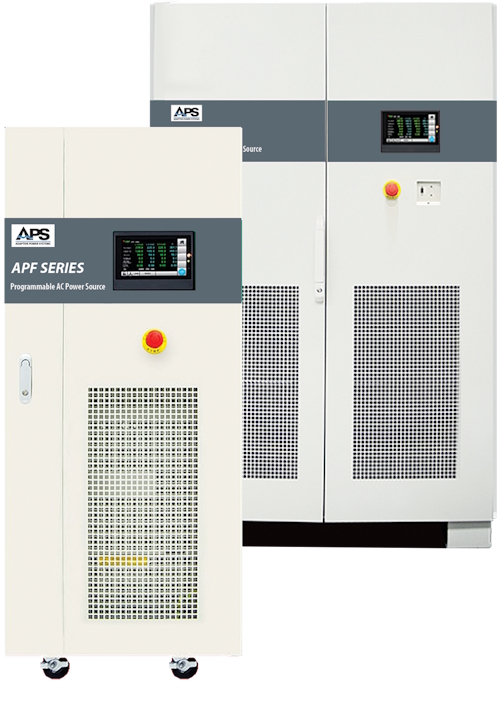
APS APF Series High Power Solid State Frequency Converters
Semantic Engineering & Strategic Evaluation

Why Modern Industrial & Defense Facilities Are Replacing Rotary Systems with Solid State Frequency Converters

In today’s interconnected global economy, electrical equipment manufactured in North America (60 Hz) must frequently operate in Europe, Asia, or South America (50 Hz), while military avionics and naval defense systems depend strictly on 400 Hz or variable-frequency shipboard power. To bridge these global voltage and frequency divides, electrical engineers and procurement directors rely on Solid State Frequency Converters (also referred to as static frequency converters).

Unlike legacy motor-generator (MG) sets that suffer from mechanical friction, carbon brush wear, harmonic distortion, and substantial idle power loss, modern solid state frequency converters leverage advanced Insulated Gate Bipolar Transistor (IGBT) pulse-width modulation (PWM) double-conversion architecture. By rectifying raw AC grid power into stabilized DC and subsequently inverting it into a pristine, programmable AC sine wave, solid state units provide unmatched voltage regulation (< 0.5%), ultra-low Total Harmonic Distortion (THD < 1.5%), dynamic transient recovery (< 1 ms), and acoustic silence suitable for quiet laboratory environments.

This technical engineering guide addresses the exact parameters global procurement managers, laboratory directors, and facility power engineers evaluate when sourcing solid state frequency conversion technology: topological differences, total cost of ownership (TCO), peak crest factors, harmonic mitigation, and long-term procurement trends through 2035.

Get a Quote

Comprehensive Solid State Frequency Conversion Portfolio

From benchtop testing to plant-wide utility conversion up to 150 kVA, Adaptive Power Systems provides precision static frequency converters tailored for R&D labs, ATE bays, and export production lines.

01 / BENCHTOP & COMPACT

FC300 Series Frequency Converters

Ideal for R&D engineering benches, quality assurance stations, and small machinery testing. Delivers single-phase and three-phase clean AC output in a space-saving chassis.

  • Power levels: 500 VA to 12 kVA single & three-phase
  • Output frequency: 45 Hz – 500 Hz programmable
  • Low THD pure sine wave output (< 1.5%)
  • Built-in digital instrumentation for V, I, P, PF, and Hz
View FC300 Specs →
02 / HEAVY INDUSTRIAL

APF1000 & APF3000 Cabinet Converters

Floor-standing high-power cabinet converters designed for entire factory test cells, burn-in bays, and global export product line commissioning.

  • Power levels: 10 kVA up to 150 kVA per cabinet
  • Wide voltage capability up to 600 Vln / 1039 Vll
  • Intuitive color touch-screen display interface
  • Isolated topology with heavy-duty transient protection
View APF Series Specs →
03 / AVIONICS & DEFENSE

400 Hz & Shipboard Power Converters

Purpose-built static converters compliant with MIL-STD-704, RTCA/DO-160, and DEF-STAN 61-5 for military aircraft ground power and naval 60Hz/400Hz systems.

  • Fixed 400 Hz avionics & variable 360 Hz – 800 Hz output
  • Dynamic overload rating up to 150% for 60 seconds
  • Galvanic isolation transformers built-in
  • Ethernet, RS232, and GPIB automation interfaces
View Defense Specs →
Engineering Insights & Information Gain

Solid State (Static) vs. Rotary Frequency Converters vs. VFDs

Selecting the right frequency conversion architecture requires evaluating electrical performance, maintenance downtime, and power quality impact on the equipment under test (EUT).

Performance Metric Solid State Converter (APS APF/FC) Rotary Converter (Motor-Generator) Variable Frequency Drive (VFD)
Operating Efficiency High (88% – 94%) across load range Low (65% – 78%) due to mechanical friction High (92% – 97%)
Output Waveform & THD Pure Sinusoidal (< 1.5% THD) Sine Wave (< 3.0% THD) with harmonic drift PWM Square Wave / High High-Frequency Noise
Transient Response Time Ultra-Fast (< 1 ms recovery) Slow (200 ms – 500 ms rotational inertia) N/A (Motor speed ramp only)
Frequency Flexibility Fully Programmable (45–500 Hz, 400Hz fixed) Fixed mechanical ratio (e.g. exactly 50Hz or 60Hz) Motor speed control only (0–120 Hz)
Acoustic Noise Level Silent to Low Fan Noise (< 62 dBA) High Loud Noise (> 85 dBA, requires isolation room) Low to Moderate
Mechanical Wear & MTBF No moving parts; MTBF > 100,000 Hours Bearings, brushes, alignment wear out regularly High solid state reliability
Target Application Export product testing, avionics, clean lab grid simulation Legacy heavy industrial raw motor drive Dedicated AC motor speed control only
Get a Quote
Engineered Solid State Frequency Converters — Ready for Custom Configuration Need line-to-neutral output up to 600V or 400Hz military testing? Speak directly with an APS application engineer.
Get a Quote
APS APF Series High Power Solid State Frequency Converters Cabinet
Facility & Export Line Grid Simulation

APF Series Cabinet Solid State Frequency Converters (10 kVA – 150 kVA)

When an entire production floor, R&D test bay, or export testing facility requires uncompromised 50Hz, 60Hz, or 400Hz power, the Adaptive Power Systems APF Series stands as the industry standard. Powered by robust IGBT inverter modules, the APF Series synthesizes line voltages up to 600 Vln (1039 V line-to-line) with precise frequency stabilization.

Designed for effortless operation, the built-in color touch-screen display allows operators to change voltage set points, set current limits, adjust output frequencies, and monitor real-time phase balance without requiring complex manual setup. Built-in RS232, USB, and Ethernet interfaces enable seamless integration into automated test environments (ATE) via standard SCPI command structures.

10 to 150 kVAScalable Cabinet Power
600 Vln / 1039 VllMax Output Line Voltage
45 Hz – 500 HzContinuous Frequency Window
< 1.5% THDLow Distortion Sine Wave
Get a Quote

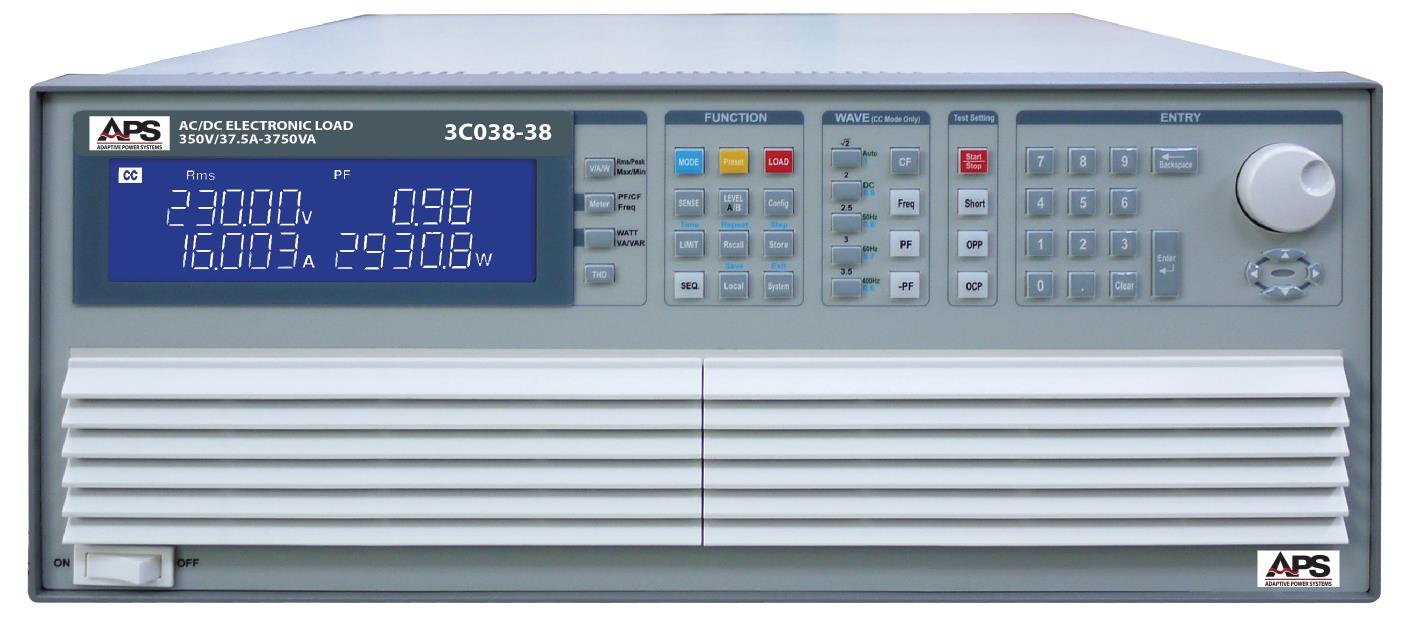
APS 3C Series Programmable AC and DC Electronic Load Front View
Closed-Loop Power Testing

Pairing Converters with APS 3C & 5VP Electronic Loads

Completing a high-rigor electrical test loop requires not only clean AC source power but also high-precision load simulation. By pairing an APS solid state frequency converter with our 3C Series AC & DC Electronic Loads or 5VP Series High-Power DC Electronic Loads, test engineers can validate grid-tied inverters, uninterruptible power supplies (UPS), EV battery chargers, and military power converters under dynamic, worst-case operating conditions.

Our programmable load banks support constant current (CC), constant voltage (CV), constant resistance (CR), and constant power (CP) modes, featuring dynamic crest factor control (1.414 to 5.0) to emulate real-world commercial loads accurately.

350 Vac / 500 VdcDual AC & DC Load Input
1.8 kW to 60 kW+Parallelable Load Capacity
PF 0.0 to 1.0Leading & Lagging Simulation
Automated ATEFull Remote GUI & API Control
Get a Quote
APS 5VP Series High Power Programmable DC Electronic Loads
EV & Aerospace Battery Simulation

High Power DC Electronic Loads for Full Test Loop Validation

For applications involving energy storage systems (ESS), electric vehicle powertrain converters, and aerospace DC bus testing (28 Vdc and 270 Vdc), the 5VPxC Series High Power DC Electronic Loads deliver up to 60 kW per single chassis. Master/slave paralleling configurations allow expansion up to multi-hundred kilowatt systems.

Featuring five pre-programmed battery discharge curves, sub-millisecond dynamic transient response, and high voltage withstand up to 1000 Vdc, the 5VP Series completes the high-power test cell portfolio offered by Adaptive Power Systems worldwide.

Up to 1000 VdcVoltage Rating
60 kW / ChassisHigh Density Capacity
5 Discharge ModesBuilt-in Battery Profiles
Fast TransientHigh Slew Rate Response
Get a Quote
Strategic Market Intelligence

Future Procurement & Technology Trends in Solid State Frequency Converters

As global energy architectures evolve toward microgrids, wide-bandgap semiconductors, and strict international compliance standards, procurement teams must align equipment investments with 10-year technology roadmaps.

1. Silicon Carbide (SiC) & GaN Switching

Next-generation solid state frequency converters are rapidly transitioning to Wide Bandgap (WBG) power semiconductors like SiC IGBTs. This technology boosts conversion efficiency past 96%, shrinks magnetics footprint by 40%, and reduces thermal dissipation requirements drastically.

2. Smart Grid & Hardware-in-the-Loop (HIL)

Global test standards (IEEE 1547, UL 1741 SA) now demand bidirectional grid simulation. Future solid state converters incorporate fast digital signal processors (DSPs) to simulate voltage sags, frequency sweeps, phase jumps, and harmonic injection in real-time under automated HIL control.

3. Modular N+1 Parallel Redundancy

Procurement teams for critical military hangars and continuous export lines prioritize modular solid state architectures. Hot-swappable power modules with N+1 active redundancy ensure zero production line downtime even if an individual power stage requires maintenance.

4. Low Total Cost of Ownership (TCO) Focus

With rising energy costs worldwide, procurement analysis extends beyond initial capital expenditure (CapEx). Solid state converters cut continuous idle power consumption by up to 80% compared to rotary generators, delivering total CapEx payback within 18 to 30 months.

Get a Quote
Enterprise Expertise & Trustworthiness

Why Enterprise Procurement Leaders Partner with Adaptive Power Systems

20+ Years Expertise (Est. 2003)

Decades of exclusive focus on engineered programmable AC power sources, DC loads, and static frequency converters.

Worldwide Sales & Service

Direct sales engineers, authorized distributors, and regional calibration centers across North America, Europe, and Asia.

Strict Compliance Verification

Full adherence to CE, UL, MIL-STD-704F, RTCA/DO-160, and ISO-9001 certified manufacturing quality standards.

Engineer-to-Engineer Support

Direct access to application engineers who assist with kVA sizing, transient load calculations, and custom ATE software scripts.

Frequently Asked Buyer Questions

Solid State Frequency Converters: Procurement & Technical FAQ

A Solid State Frequency Converter (static frequency converter) uses double-conversion power electronics (AC to DC, then DC to regulated AC) to change utility power frequency (e.g., 50 Hz to 60 Hz or 400 Hz) and voltage. Unlike motor-generator rotary sets, solid state converters contain no moving parts, resulting in quiet operation, high efficiency (>90%), low maintenance, and exact voltage regulation (<0.5%). Unlike Variable Frequency Drives (VFDs) designed solely to adjust AC motor speeds via crude pulse-width modulated square waves, solid state frequency converters deliver pure, low-distortion sinusoidal power (THD < 1.5%) safe for sensitive electronics, laboratory testing, and facility grid conversion.

Aircraft and military systems utilize 400 Hz AC power because higher electrical frequencies drastically reduce the weight and size of transformers, motors, and magnetic components—a crucial factor in aerospace design. When testing avionics, radar, flight control systems, or ground support equipment in civilian facilities supplied with 50 Hz or 60 Hz utility power, a solid state frequency converter is essential to synthesize clean, stable 400 Hz power compliant with MIL-STD-704F, RTCA/DO-160, and ARINC specifications.

Inductive motor loads and non-linear power supplies present high peak inrush currents upon startup (locked rotor current). Procurement teams must evaluate both continuous kVA and peak crest factor (typically 3:1 to 4:1). For direct-on-line (DOL) AC motor starting, select a solid state frequency converter rated for 3 to 5 times the motor's running kVA capacity. Alternatively, utilize the programmable soft-start voltage ramp features of APS APF Series converters to limit starting current surges and optimize initial system sizing.

Yes. Adaptive Power Systems APF Series three-phase solid state frequency converters feature independent phase regulation. They maintain precise voltage balance (< 1% line-to-line variation) even when subjected to 100% unbalanced loads across phases, protecting sensitive EUTs from phase voltage unbalance failure.

APS frequency converters support comprehensive digital automation via Ethernet (LAN), USB, RS232, and optional GPIB (IEEE-488.2) interfaces. Our instruments feature standard SCPI syntax, allowing simple integration into LabVIEW, Python, MATLAB, C#, or custom test executive environments. Free Windows GUI software is also included for benchtop control and telemetry logging.

Click the Get a Quote button on this page to initiate an immediate technical session with our global sales engineering team. We provide rapid price quotes, detailed technical proposals, lead time estimates, and custom cabinet configuration assistance based on your regional input utility and EUT requirements.

Get a Quote
Technical Inquiry & Rapid Quotation

Specify Your Solid State Frequency Converter Solution Today

Whether you require a 1 kVA bench converter for export QA or a 150 kVA plant-wide 400Hz avionics supply cabinet, our application engineers are standing by to review your power envelope and recommend the optimal solution.

Get a Quote Find a Local Representative