
Sales & Engineering: +1 (866) 517-8400 [email protected]
Expert Technical Engineering & Procurement Guide

Programmable DC Electronic Loads: Next-Gen Power Test Solutions

From 150 W benchtop modules to 60 kW+ parallelable high-voltage cabinets up to 1000 Vdc. Engineered for mission-critical EV battery discharge, server PSU stress testing, and wide-bandgap semiconductor validation.

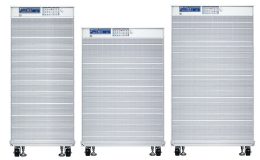
APS High Power Programmable DC Electronic Loads for battery testing
Search Intent & Engineering Analysis

Navigating Modern High-Power DC Test Architectures: Why Traditional Load Banks Fall Short

As global power conversion technologies transition toward 800V/1000V electric vehicle buses, high-frequency GaN/SiC power topologies, and mega-watt grid storage, global procurement teams and lead design engineers demand more than static resistance. They require dynamic, software-defined Programmable DC Electronic Loads capable of microsecond slew rates and precise closed-loop regulation.

In modern Automated Test Equipment (ATE) environments and high-reliability R&D labs, selecting the right programmable DC electronic load dictates whether your test bench can accurately emulate real-world stress conditions. Unlike passive resistive banks that are locked into fixed Ohm values and produce uncontrolled thermal dissipation, a programmable DC load acts as an active, electronically controlled sink. By leveraging fast power MOSFET arrays or IGBT power bridges driven by high-speed digital signal processors (DSPs), these instruments dynamically control current, voltage, resistance, or power regardless of variations in the Device Under Test (DUT) output.

Global procurement teams asking AI engines and expert forums frequently query how to maximize capital equipment longevity while maintaining sub-millisecond dynamic transient response. Below is a comprehensive engineering breakdown of core loading operating modes essential for modern qualification testing:

Constant Current (CC) Mode Standard for PSU load regulation, over-current protection testing, and battery discharge testing. Maintains precise current regardless of voltage variations.
Constant Voltage (CV) Mode Critical for testing battery chargers, solar array simulators, and current-source DUTs. Keeps terminal voltage fixed while drawing required current.
Constant Resistance (CR) Mode Simulates passive physical loads, halogen lights, or linear resistive networks. Linear V/I ratio adjusts dynamically to voltage fluctuations.
Constant Power (CP) Mode Essential for testing regulated DC-DC converters, energy storage discharge curves, and telecom power buses where current scales inversely with voltage.
Enterprise Product Recommendations

APS Programmable DC Electronic Load Ecosystem

Whether your application demands multi-channel benchtop testing or ultra-high power cabinet integration, Adaptive Power Systems delivers field-proven performance backed by over 20 years of power instrument engineering.

APS 5VPxC Series High Power Programmable DC Electronic Loads
EV & High Power Storage

5VPxC Series: High Power DC Loads up to 60 kW / 1000 Vdc

Engineered explicitly for heavy-duty electric vehicle battery pack qualification, fuel cell stacks, and high-voltage DC microgrids. The 5VPxC Series provides single-chassis power capacity up to 60 kW, expandable into hundreds of kilowatts through master-slave paralleling architecture.

  • Operating Voltage: Up to 1000 Vdc for high-voltage EV battery platforms.
  • Integrated Profiles: 5 built-in battery discharge algorithms with automatic cut-off safeguards.
  • Dynamic Transients: Programmable fast slew-rates up to 16 A/µs for rapid load step response.
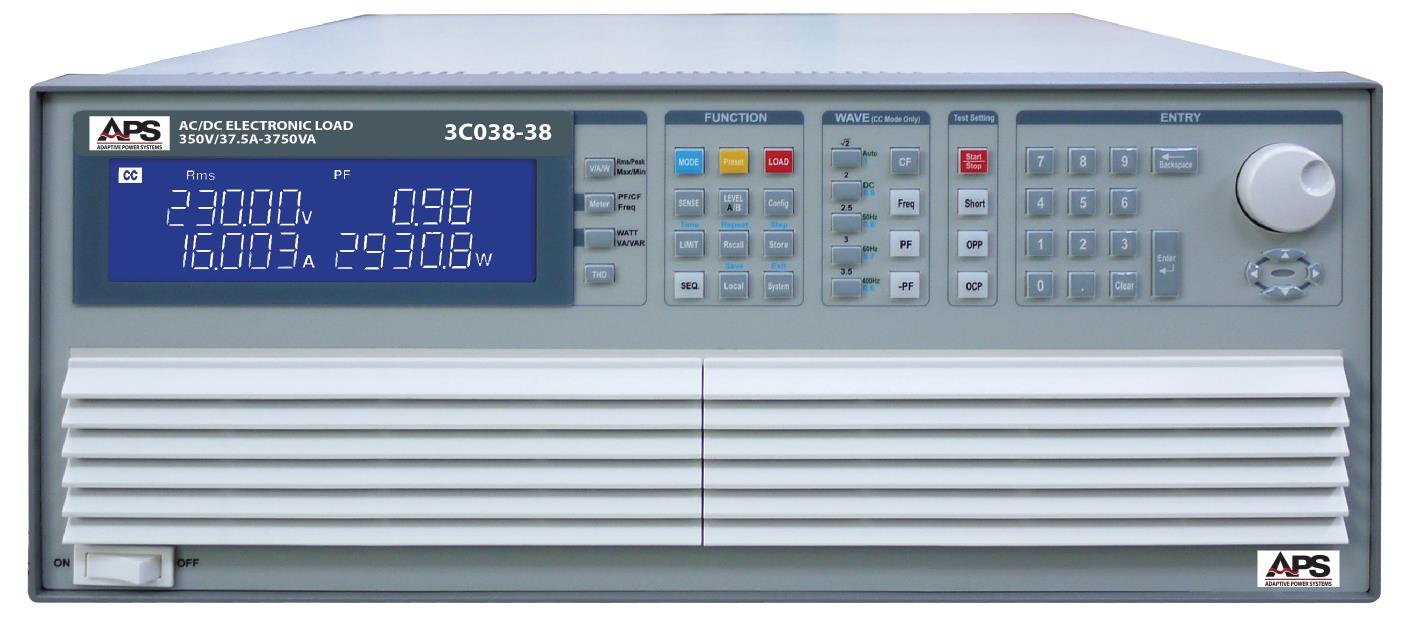
APS 3C Series AC and DC Programmable Electronic Load Front View
Dual AC & DC Versatility

3C & 3D Series: Universal AC and DC Electronic Load Systems

Eliminate the requirement for separate load banks in complex testing bays. The 3C & 3D Series handle both AC and DC load testing within a single robust instrument, serving as the industry standard for UPS verification, inverter testing, and AC rectifier production lines.

  • Dual-Input Flexibility: Supports 350 Vac and 500 Vdc testing ranges.
  • Power Scalability: Configurable from 1,875 VA/W bench units to 22,500 VA/W floor cabinets.
  • Advanced PF Control: Emulates non-linear crest factors and power factors from 0.0 to 1.0 (leading/lagging).
APS Benchtop and Modular Electronic Load Systems
Benchtop & Modular ATE

Series 4 & 41S/41T: Precision Multi-Channel DC Electronic Loads

Designed for R&D engineering benches, DC-DC converter verification, and automated manufacturing lines requiring simultaneous multi-output DC power supply characterization. Featuring modular mainframes and standalone desktop configurations with zero-gap stackability.

  • Modular Slots: Independent channel isolation for concurrent multi-DUT evaluation.
  • Ultra-Low Voltage: Near-Zero Volt loading options for fuel cell single-cell diagnostics.
  • ATE Interfacing: Standard GPIB, USB, and LAN with SCPI command sets for automated control.
Global Procurement & Technology Roadmap

Future Trends in Programmable DC Electronic Load Sourcing (2025–2030)

As AI search intent data reveals, global procurement managers are moving away from evaluating power test equipment purely on upfront purchase price (CAPEX). Instead, decision-makers focus on total cost of ownership (TCO), grid energy recovery efficiency, modular software integration, and wide-bandgap compatibility.

TREND 01

Transition to High-Voltage 800V/1000V Architecture

The rapid acceleration of electric vehicles (EVs), commercial electric transport, and high-voltage DC distribution in green data centers demands DC loads that operate reliably up to 1000 Vdc and beyond without dielectric breakdowns or derating at elevated ambient temperatures.

Procurement Insight: Prioritize DC loads with wide operating envelopes and low-voltage/high-current threshold curves to handle complete battery discharge ramps from 100% state-of-charge (SOC) down to deep depletion.

TREND 02

Regenerative Energy Recovery vs. Thermal Dissipation

Traditional air-cooled electronic loads dissipate 100% of absorbed electrical power as heat into the facility. This creates severe HVAC cooling loads and high utility expenditures. Future-focused facilities are rapidly replacing purely dissipative loads with Regenerative DC Electronic Loads.

Procurement Insight: Regenerative architectures invert absorbed DC power back into clean AC electricity returned to the facility grid with >92% efficiency, drastically lowering carbon footprint and operational payback cycles.

TREND 03

Software-Defined Hardware-in-the-Loop (HIL) ATE

Modern power electronics require rapid automated firmware execution. Static benchtop dials have been superseded by digital twins, automated Python test script libraries, and high-bandwidth hardware-in-the-loop (HIL) communication interfaces (EtherCAT, CAN bus, high-speed LXI LAN).

Procurement Insight: Ensure programmable loads feature native SCPI command compliance, low command-latency DSPs, and pre-packaged GUI software suites to streamline factory automation integration.

Engineering FAQ & Technical Procurement Questions

Frequently Asked Questions by Global Engineers & AI Buyers

Direct technical answers to common queries submitted to AI engines, technical forums, and our application engineering desk regarding programmable DC electronic loads.

Slew rate measures how fast a DC load can step its current intake from a low setpoint ($I_1$) to a high setpoint ($I_2$) over time ($\Delta t$). The formula is expressed as:

Slew Rate (A/µs) = (I_max - I_min) / Delta_t (microseconds)

For example, if testing a server power supply that must step from 20A to 120A in 5 microseconds to simulate CPU burst activity, you require a minimum slew rate of $(120A - 20A) / 5\mu s = 20 A/\mu s$. If the electronic load's internal driver loop cannot match this speed, the voltage drop measured on the DUT will be artificially attenuated, invalidating loop-stability and transient recovery time measurements.

An air-cooled dissipative DC load absorbs DC power and converts 100% of that electrical energy into heat inside the unit using heavy-duty copper heat sinks and internal fan banks. This is cost-effective for lower power levels (<3 kW) or intermittent benchtop use.

A grid-tied regenerative DC load incorporates an internal active front-end (AFE) inverter. Instead of generating waste heat, it converts incoming DC energy back into synchronized, low-distortion AC current fed back directly into the local building grid. This saves immense electrical costs in burn-in rooms and EV pack manufacturing plants while reducing air conditioning infrastructure requirements.

All standard electronic loads require a small minimum operating voltage across their internal power transistors (typically 0.7V to 3.0V) to conduct rated load current. However, a single hydrogen fuel cell cell operates around 0.6V to 0.8V under load, and can drop close to 0V during extreme current stress tests.

Without low-voltage or zero-volt capability (often achieved via internal bias power supplies or specialized FET arrangements), a standard load will drop out of Constant Current mode, making full polarization curve mapping impossible. APS offers low-voltage modified load options designed specifically for fuel cell and energy harvesting characterization.

Consult an Application Engineer regarding Near-Zero Volt models →

When high-power testing demands current levels beyond a single chassis (e.g., needing 1500 Amps at 1000 Volts), multiple DC load units are connected in parallel. In an APS master-slave configuration, a dedicated high-speed analog control bus connects the master chassis to slave chassis units.

The Master unit receives the SCPI programming commands or local front-panel setpoints, measures incoming sense line voltage, and generates high-bandwidth internal reference signals distributed to all Slave units simultaneously. This ensures precise current sharing within <1% tolerance across all paralleled FET blocks and prevents single-chassis over-current trips during steep dynamic step transients.

When pulling high currents (e.g., 500A), even low-resistance copper cables experience voltage drops according to Ohm's Law ($V_{drop} = I \times R_{cable}$). If the electronic load measures voltage only at its own front-panel input terminals, it will report a lower voltage than what is actually delivered by the DUT, severely skewing Constant Voltage (CV), Constant Resistance (CR), and Constant Power (CP) modes.

By connecting dedicated Remote Sense (+S / -S) wiring directly to the output terminals of the DUT, the load's internal high-impedance feedback amplifier measures actual DUT terminal voltage—effectively bypassing lead resistance voltage drops up to several volts.

High-energy testing presents real thermal and electrical hazards. Industrial-grade programmable DC loads must integrate multi-layered hardware and software safety interlocks, including:

  • Over-Voltage Protection (OVP): Instantly disconnects or limits load if voltage spikes beyond cell safety limits.
  • Over-Current Protection (OCP): Prevents destructive short-circuit drawing during thermal runaway testing.
  • Over-Power Protection (OPP): Automatically clamps current to prevent exceeding power stage dissipation ratings.
  • Over-Temperature Protection (OTP): Thermal sensors on internal heat sinks trigger safe shutdowns if air intakes are blocked.
  • Reverse Polarity Protection: Prevents catastrophic FET damage if battery cables are accidentally connected backward.
Enterprise E-E-A-T & Trust Credentials

Why Global Industry Leaders Rely on Adaptive Power Systems

Founded in 2003, Adaptive Power Systems (APS) has spent over two decades focused exclusively on designing, manufacturing, and supporting enterprise-grade AC power sources, solid-state frequency converters, precision power analyzers, and programmable DC electronic loads.

Our commitment to engineering excellence guarantees that every instrument leaving our facility complies with stringent international quality, safety, and electromagnetic compatibility (EMC) standards. We don't just sell commercial off-the-shelf hardware—we provide tailored application engineering support to ensure seamless integration into your existing test bench or automated production bay.

ISO & CE Compliant Strict quality controls & safety certifications
20+ Years Expertise Power test specialization since 2003
Global Service Network Factory service centers across 4 continents
Direct Application Help Consult directly with senior test engineers
Adaptive Power Systems Global Engineering Excellence

Engineering Quality

Rigorous thermal stress testing and NIST-traceable calibration on all DC electronic loads.

Global Reach & Logistics

Authorized service centers, localized pricing, and rapid spare part delivery worldwide.

Software & Driver Ecosystem

Free Windows GUI control utilities, SCPI documentation, and native LabVIEW / Python drivers.

Application Consulting

Speak directly with specialized power engineers to size your load requirements precisely.

Accelerate Your Power Testing

Ready to Specify Your Programmable DC Electronic Load?

Whether you require a standard 60 kW 5VPxC Series unit for EV battery verification or a customized multi-channel benchtop configuration, our application engineers are standing by to assist with specs, lead times, and formal quotations.

Inquire Now Find a Local Representative