Sales & Engineering: +1 (866) 517-8400 [email protected]
Engineering & Procurement Master Guide

High Power DC Electronic Loads

Scalable power sinks from 6 kW to over 60 kW per chassis up to 1000V. Precision static and dynamic transient loading engineered for EV battery packs, fuel cells, aerospace power grids, and server power distribution.

APS 5VP Series High Power DC Electronic Load Chassis
Technical Evaluation & Information Gain

High Power DC Electronic Loads: Architectural Fundamentals & Sourcing Evaluation

Modern electrical engineering requires rigorous validation of energy storage systems, high-voltage automotive traction batteries, solar inverter arrays, and mission-critical DC microgrids. A High Power DC Electronic Load acts as a programmable power sink, precisely emulating real-world electrical stress factors under controlled laboratory and automated test equipment (ATE) production environments.

When global procurement teams, test engineers, and chief technology officers evaluate high power DC loads, the core objective goes beyond selecting basic voltage and current ratings. It demands a thorough technical understanding of energy dissipation capabilities, control loop response times, dynamic slew rate limits, and safety interlocks that safeguard both the device under test (DUT) and laboratory personnel.

Key Engineering Takeaway: Power Density & Master-Slave Scalability

Standard electronic loads often hit thermal and operational limits when required to sink currents in excess of 1,000 Amperes or handle step voltages near 1,000 Volts DC. Adaptive Power Systems solves this challenge by leveraging advanced master-slave digital control topologies in the 5VPxC Series, enabling multi-chassis parallel arrays operating as a single unified load up to hundreds of kilowatts with zero performance degradation in command latency or measurement accuracy.

Operating Modes: Matching Intent to Application Demands

To accurately simulate complex electrical loads, programmable DC electronic loads operate across four foundational static control modes, supplemented by high-speed dynamic transient modes:

  • Constant Current (CC) Mode: The load sinks a steady programmable current level regardless of input voltage shifts. Essential for testing power supply load regulation, battery capacity discharge curves, and fuel cell current-voltage (I-V) characterization.
  • Constant Voltage (CV) Mode: The load regulates terminal voltage to a set target by drawing whatever current is necessary. Crucial for verifying battery chargers, current-limited power converters, and solar PV array maximum power point tracking (MPPT) algorithms.
  • Constant Resistance (CR) Mode: Emulates a fixed physical resistor by controlling current proportional to input voltage in accordance with Ohm's Law. Ideal for evaluating DC-DC converters during startup and power-up sequence behavior.
  • Constant Power (CP) Mode: Sinks a precise wattage level by automatically calculating current based on measured terminal voltage. Perfectly mimics regulated DC-DC converters, electric vehicle motor drives, and advanced power management integrated circuits (PMICs).
APS Flagship Product Lineup

High Power DC Electronic Load Portfolio

From high-density standalone chassis to modular multi-channel bench units, Adaptive Power Systems provides versatile, highly reliable instruments designed for extreme industrial test environments.

01 / HEAVY-DUTY INDUSTRIAL

5VPxC Series High Power DC Loads

Engineered for high-capacity EV battery packs, energy storage systems (ESS), and fuel cell testing. Up to 60 kW per chassis with scalable paralleling up to 1000V DC.

  • Voltages up to 1000 Vdc, currents up to 1500 A
  • 5 built-in battery discharge automated profiles
  • Master/slave control interface for parallel expansion
Get a Quote →
02 / HYBRID AC & DC

3C & 3D Series AC & DC Loads

Versatile dual-capability instruments capable of handling both AC and high-voltage DC load requirements for UPS, PV inverter, and industrial rectifier testing.

  • Input ranges up to 350 Vac and 500 Vdc
  • Power ratings from 1,875 VA/W to 22,500 VA/W per unit
  • Leading & lagging power factor control (0.0 to 1.0)
Get a Quote →
03 / MODULAR BENCH & ATE

4 Series & 41S/41T Series DC Loads

Precision modular loads for multi-output DC power supply burn-in, automotive ECU testing, and space-constrained engineering design benches.

  • Single and dual channel mainframe plug-in modules
  • High accuracy readback for voltage, current & power
  • GPIB, USB, and LAN ATE automation interfaces
Get a Quote →
APS 5VP Series high power programmable DC electronic loads
Flagship Power Solution

5VPxC Series: 60 kW per Chassis High Power DC Loads

The 5VPxC Series represents the peak of high-power DC load engineering. Designed specifically to answer the demands of modern electric vehicle (EV) battery validation, commercial energy storage systems (ESS), and megawatt-scale power conversion facilities, the 5VPxC delivers uncompromised accuracy and thermal stability.

With integrated protection modes (OPP, OCP, OVP, OTP, and Reverse Polarity), dynamic frequency sweep controls, and automated battery lifecycle test scripts, this unit cuts test setup time in half while providing peak data fidelity.

1000 VdcMax Operating Voltage
Up to 60 kWPer Chassis Footprint
5 ProfilesAutomated Battery Algorithms
SynchronizedMaster/Slave Architecture
Get a Quote
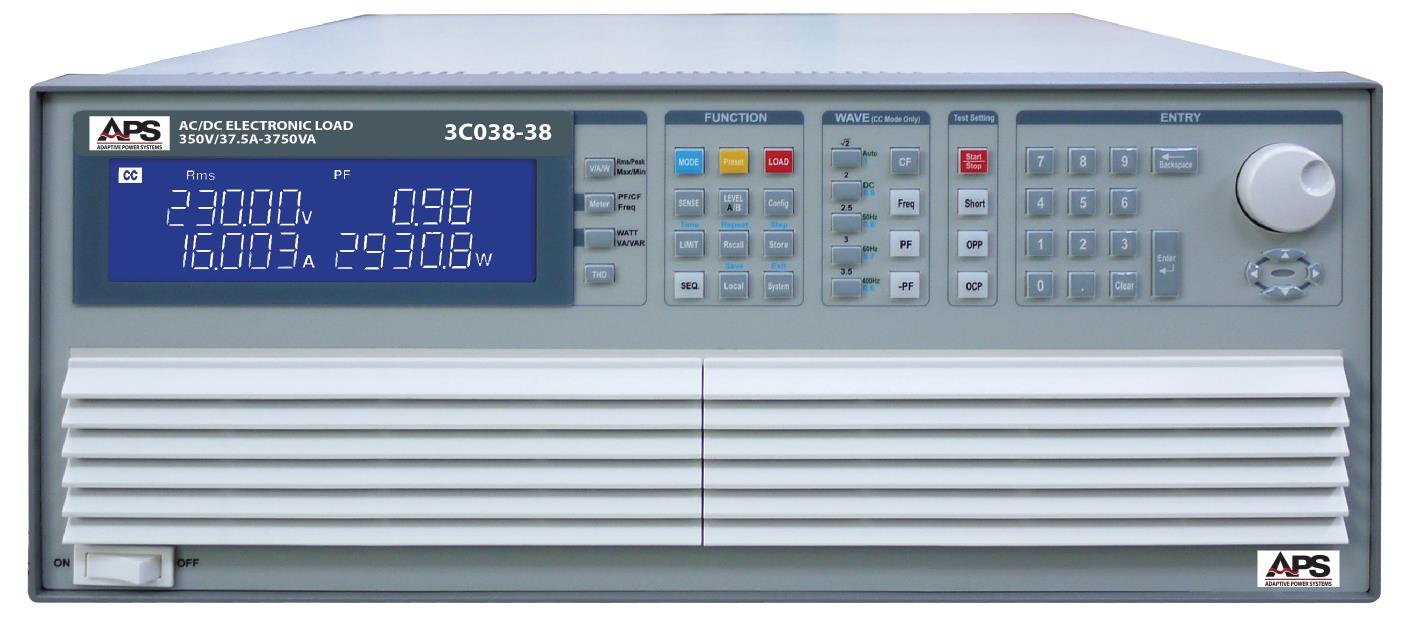
APS 3C Series AC and DC Programmable Electronic Load
Multi-Mode Test Versatility

3C Series: Integrated AC and DC Electronic Loading

Simplifying complex testing labs that evaluate dual-output power systems, the 3C Series eliminates the need for separate AC and DC load chassis. Capable of handling up to 350 Vac and 500 Vdc, it offers programmable crest factor, power factor adjustments, and high-speed dynamic transient stepping.

Whether testing single-phase UPS systems, three-phase grid-tied PV inverters, or DC traction supplies, the 3C Series provides seamless remote bus integration via standard SCPI command sets.

350V / 500VAC & DC Input Capability
22.5 kVA/kWSystem Power Rating
0.0 to 1.0Programmable Power Factor
GPIB / LANFully Automated Ready
Get a Quote
Procurement Specification Matrix

Technical Comparison of High Power DC Electronic Load Architecture

Selecting the correct DC load configuration requires comparing voltage boundaries, maximum current absorption, transient response, and control interface flexibility. The table below outlines key technical parameters across Adaptive Power Systems' high power DC load families.

Feature / Model 5VPxC High Power Series 3C / 3D AC & DC Series 4 Series Modular DC Loads 41S / 41T Standalone Series
Max Power Range 6 kW to 60 kW (Parallelable) 1.875 kW to 22.5 kW 150 W to 1200 W per mainframe 150 W to 600 W per benchtop
Voltage Range 60 V to 1000 Vdc 50 V to 500 Vdc / 350 Vac 60 V to 500 Vdc 60 V to 500 Vdc
Max Current Sink Up to 1500 A per unit Up to 180 A Up to 240 A (module combined) Up to 120 A
Operating Modes CC, CV, CR, CP, Dynamic, Battery CC, CR, CP, CV, AC Rectifier CC, CV, CR, CP, Short Circuit CC, CV, CR, CP, Dynamic
Transient Response Fast Slew Rate (< 2.5 A/µs) High-speed dynamic stepping Microsecond transient edge High-speed dynamic pulsing
Target Applications EV Batteries, ESS, Fuel Cells, Microgrids UPS, PV Inverters, AC/DC Supplies ATE Systems, Multi-output PSUs R&D Bench, QC Inspection
Get a Quote
Industry Market Insights

Global Procurement & Future Technology Trends in High Power DC Load Testing

As the global energy transition accelerates, procurement departments in automotive, aerospace, defense, and renewable energy sectors face evolving testing standards. Understanding emerging technological shifts ensures that capital equipment investments made today remain viable over a 10-to-15-year operational lifecycle.

1. Transition to 800V and 1000V EV Powertrain Architecture

Automotive Original Equipment Manufacturers (OEMs) and Tier-1 suppliers are rapidly shifting from 400V battery architectures to 800V+ architecture to enable ultra-fast charging (UFC) and increase powertrain efficiency. Consequently, procurement requirements for DC electronic loads have pivoted sharply toward instruments capable of continuous operation at 1000 Vdc while maintaining high current sinking ability at lower voltage thresholds.

2. High-Power Fuel Cell Stack Characterization

Hydrogen fuel cell stack development demands unique load capabilities. Fuel cell polarization curve testing requires continuous current absorption down to near 0 Vdc while sustaining hundreds of Amperes. Advanced DC electronic loads integrated with zero-voltage loading capability (ZVL) and ultra-low internal resistance profiles are quickly becoming mandatory specification requirements for hydrogen clean-tech laboratories.

3. Grid-Tied Regenerative Energy Sinking vs. Air Cooling

With corporate sustainability mandates and rising operational electricity costs, test facilities running continuous 24/7 burn-in testing are scrutinizing heat dissipation. Conventional air-cooled DC loads convert 100% of absorbed electrical power into ambient heat, requiring substantial HVAC capital expenditure. Future procurement trends strongly favor high-efficiency thermal architectures and regenerative grid-tied systems that recover absorbed DC energy and feed it back to the facility AC grid with conversion efficiencies exceeding 92%.

4. AI-Driven Datacenter DC Power Distribution (48V to 800V Bus)

The explosive growth of AI computing infrastructure requires high-density datacenter server racks consuming upwards of 100 kW per rack. Next-generation power distribution units (PDUs) and intermediate bus converters (IBCs) rely on high-power DC loads capable of simulating millisecond peak dynamic transient step loads. The ability to program complex pulse sequences via digital interfaces is a primary driver in modern electronics procurement.

Engineered Excellence Since 200320+ years of dedicated programmable AC & DC power expertise trusted by fortune 500 aerospace, defense, and EV leaders worldwide.
Get a Quote
Why Adaptive Power Systems

Enterprise E-E-A-T: Technical Authority & Service Reliability

Adaptive Power Systems (APS) has provided industry-leading programmable power sources, frequency converters, and electronic load instruments to global engineering teams since 2003. When sourcing critical high-power test hardware, APS provides verified experience, expertise, authoritativeness, and trust (E-E-A-T):

  • Proven Field Experience: Thousands of high-power DC load chassis installed across North America, Europe, and Asia Pacific, operating reliably in mission-critical aerospace, automotive, and defense laboratories.
  • Engineering Support Expertise: Direct access to senior application engineers who specialize in configuring complex master-slave systems, safety interlocks, and custom load profiles.
  • Traceable Quality & Compliance: Manufactured under strict quality management processes, fully compliant with international safety, CE, and EMC standards, backed by ISO-traceable calibration documentation.
  • Worldwide Service Network: Supported globally by independent sales representatives, regional technical service hubs, and factory-trained repair centers to ensure minimal downtime for your test lines.
Buyer & Engineer Knowledge Base

Frequently Asked Procurement & Technical Questions

Selecting the optimal operating mode depends directly on the electrical characteristics of the Device Under Test (DUT):

• Constant Current (CC): Ideal for evaluating load regulation of DC power supplies, testing fuel cell polarization curves, and executing controlled battery capacity discharge runs.
• Constant Voltage (CV): Used when testing current-limited battery chargers or solar PV maximum power point tracking (MPPT) circuits where the load must hold a fixed voltage baseline.
• Constant Resistance (CR): Simulates passive resistive components, frequently applied in DC-DC converter turn-on behavior validation.
• Constant Power (CP): Essential for testing battery management systems (BMS) and downstream regulated DC converters that draw constant power despite input voltage fluctuations.

When paralleling high-power DC electronic loads, current balance and dynamic synchronization are critical. Ensure the following factors are addressed:

1. Master-Slave Digital Bus: Select loads like the APS 5VPxC Series that feature a dedicated digital master-slave communication interface. This guarantees that commands sent to the master unit are simultaneously executed across all slave units without latency delays.
2. Low-Inductance Symmetrical Wiring: Use equal-length, twisted-pair power cables between the DUT and each load chassis terminal to prevent current imbalance caused by unequal cable resistance or stray inductance.
3. Thermal Management: Verify adequate rack spacing and airflow exhaust clearance, as paralleled systems dissipate significant kilowatt-level heat loads during continuous testing.

High current flowing through heavy-gauge copper cables creates an inherent IR voltage drop (V_drop = I × R_cable). For example, sinking 500 A through cables with just 2 mΩ of total resistance leads to a 1.0 V drop. If the electronic load measures voltage strictly at its front or rear input terminals, it will report a voltage significantly lower than the actual voltage present at the DUT terminals.

Remote voltage sensing uses a pair of high-impedance signal wires connected directly from the load's sense inputs to the DUT terminals. Because virtually zero current flows through these sense leads, the internal meter measures the exact DUT terminal voltage, enabling precise CV, CR, and CP control and highly accurate data logging.

High-energy DC discharge testing carries risks of over-voltage, thermal runaway, and reverse polarity wiring errors. Essential protection features built into industrial DC electronic loads include:

• Over Voltage Protection (OVP): Instantly shuts down the load inlet to prevent internal transistor breakdown if DUT voltage exceeds safe limits.
• Over Current Protection (OCP): Triggers latching shutdown if load current exceeds maximum rating.
• Over Power Protection (OPP): Dynamically restricts total wattage absorption to protect internal heatsinks.
• Over Temperature Protection (OTP): Thermal sensors monitor internal power FETs and shut down the unit if cooling airflow is restricted.
• Reverse Polarity Protection: Prevents short-circuit current spikes if DC leads are accidentally swapped.

Conventional air-cooled DC electronic loads dissipate 100% of absorbed electrical power as heat into the laboratory room. Operating a 50 kW load continuously requires approximately 50 kW of additional HVAC cooling power, doubling operational electrical expenditure.

Selecting high-density loads with intelligent fan speed control or energy-regenerative architectures reduces heat output, drastically cuts monthly facility utility bills, extends component lifespans, and reduces overall capital investment in lab cooling systems.

APS 5VPxC Series loads feature fast programmable slew rates (up to several Amperes per microsecond), multi-step dynamic sequence modes, and built-in battery discharge algorithms. Engineers can upload complex transient profile tables (such as WLTP, US06, or custom automotive dynamic loading cycles) directly into memory using SCPI commands over LAN, USB, GPIB, or RS232 interfaces for real-time automated execution.

Technical Inquiry & Custom Sizing

Accelerate Your Power Testing Capabilities Today

Contact Adaptive Power Systems to review your voltage, current, and dynamic load requirements with a senior application engineer. We will configure the optimal high power DC electronic load solution for your lab.

Get a Quote Visit Technical Support