
Sales & Engineering: +1 (866) 517-8400 [email protected]
0%

China has become a major source of programmable power testing equipment, serving laboratories, factories, universities, and renewable energy projects. Programmable DC Electronic Loads help engineers evaluate batteries, adapters, power supplies, chargers, and control systems under repeatable conditions. Their displays may show voltage, current, power, resistance, and temperature within seconds. Small details matter.

This introduction presents ten notable Chinese manufacturers associated with programmable DC electronic loads. The comparison considers product range, rated power, operating modes, response speed, measurement accuracy, cooling design, software support, and after-sales service. It also examines practical features, including constant-current, constant-voltage, constant-resistance, and constant-power modes. Some models support dynamic load testing, remote control, data logging, and automated production-line integration. These capabilities can reduce manual testing and reveal unstable output before products reach customers.

A ranking is never permanent. Manufacturer information, export experience, and published specifications can change quickly. Some companies provide detailed datasheets, calibration information, and test reports, while others disclose less. That weakness deserves attention. Buyers should verify maximum voltage, current limits, transient performance, protection functions, and warranty terms directly with each supplier. Factory visits, sample testing, and independent measurements may expose differences hidden by similar brochures. The ten companies discussed here are not suitable for every application. High-power battery testing needs a different solution from a compact laboratory bench. Careful comparison remains essential.
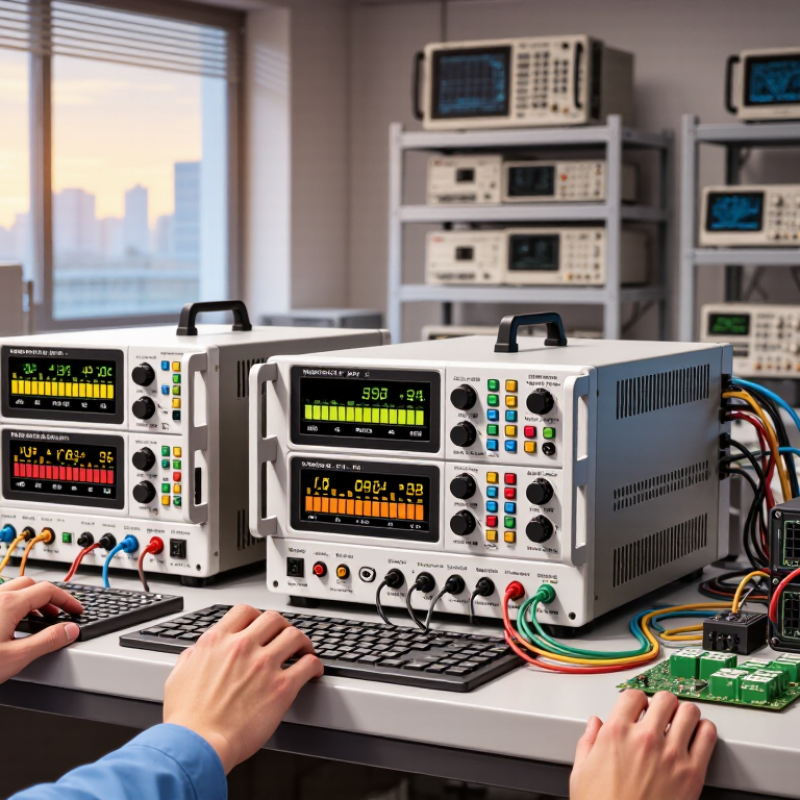
China Top 10 Programmable DC Electronic Load Manufacturers

What Is a Programmable DC Electronic Load?

A programmable DC electronic load is a test instrument that draws controlled electrical power from a source. It can imitate a real device, battery, motor controller, or charging circuit. Unlike a fixed resistor, it changes its demand through software or front-panel controls. The operator can set constant current, constant voltage, constant resistance, or constant power modes. It then measures voltage, current, power, and sometimes energy over time.

Inside the load, power semiconductors regulate current through a feedback circuit. The absorbed energy becomes heat, so cooling capacity matters. During bench testing, an engineer may connect a 24-volt supply, set a 2-ampere load, and observe voltage stability for several minutes.

Dynamic modes can switch between low and high current levels, revealing weak transient response. Communication interfaces also allow automated tests, data logging, and repeatable production checks.

A reliable setup begins with the ratings. Check maximum voltage, current, power, and pulse duration before connecting equipment. A load rated for 300 watts may not sustain that level without proper airflow.

This is often overlooked.

Wiring resistance can also distort results, especially at high current. Remote sensing helps compensate for cable drops, but it cannot correct poor connections. Protection features such as overtemperature, overvoltage, and reverse-polarity safeguards improve safety. Still, they are not a substitute for careful setup. Mistakes happen, particularly when test scripts use incorrect limits. Verification with an independent meter remains worthwhile.

How to Evaluate Programmable DC Electronic Load Manufacturers

Evaluating programmable DC electronic load manufacturers in China requires more than comparing prices. I start with the load’s operating envelope: voltage, current, power, and temperature derating. A 1,200-watt unit may reach that rating only below 30°C. That detail matters.

According to the IEA Global EV Outlook 2024, nearly 14 million electric cars were sold worldwide in 2023. This growth increases demand for repeatable battery and power-conversion tests. Manufacturers should therefore provide verified constant-current, constant-voltage, constant-resistance, and constant-power modes.

Check transient response, slew-rate control, ripple, measurement accuracy, and protection thresholds. Ask for test conditions, not marketing values. A clear calibration certificate, traceable to national standards, strengthens reliability.

Communication also deserves close inspection. SCPI support, remote sensing, data logging, and stable interfaces reduce operator errors during long test cycles. Compliance with IEC 61010-1 should be documented, especially for high-energy systems. I also examine service response, spare-part availability, firmware control, and repair procedures. MarketsandMarkets’ 2024 electronic test equipment analysis identifies automation and connected testing as important growth drivers, making software support increasingly practical. Still, a polished interface cannot repair poor thermal design. I have seen specifications look excellent while fan noise, heat drift, or parallel-operation limits caused problems. Independent sample testing is wiser than trusting a single datasheet. Cost matters, but repeatability matters more.

China’s Top 10 Programmable DC Electronic Load Manufacturers

China’s Top 10 Programmable DC Electronic Load Manufacturers

China’s programmable DC electronic load sector is expanding with battery, power supply, and automotive testing demand. The China Association of Automobile Manufacturers reported 12.866 million new-energy vehicle sales in 2024. This growth increases the need for controlled discharge testing and repeatable power validation.

Performance matters more than catalog size. The strongest manufacturers typically provide constant-current, constant-voltage, constant-resistance, and constant-power modes. Fast transient response is also essential when engineers simulate real charging changes.

Buyers should verify voltage accuracy, current resolution, thermal protection, and calibration traceability. These details affect test repeatability.

The International Energy Agency’s Global EV Outlook 2025 reported that China produced more than 70% of global electric cars in 2024. That scale supports a broad domestic supplier base, but rankings remain imperfect. Public specifications can hide differences in firmware stability, cooling design, and after-sales support.

I have found that practical verification often reveals more than a polished brochure. Test the control software. Check the noise floor. Review service records and laboratory certificates before purchasing. A lower listed price may create higher costs during long-duration testing.

Key Features and Applications of Leading Chinese Brands

Chinese programmable DC electronic load manufacturers now serve laboratories, production lines, and power-system developers worldwide. Leading suppliers commonly offer constant-current, constant-voltage, constant-resistance, and constant-power modes. These functions help engineers reproduce real operating conditions with controlled accuracy. Many models support fast transient testing, remote sensing, and parallel operation. Protective features may include overvoltage, overcurrent, overheating, and reverse-polarity safeguards. Clear displays and software interfaces also reduce setup errors during repeated tests.

Battery engineers use these loads for discharge curves, capacity checks, and protection testing. Power-supply developers apply them to efficiency, regulation, and startup evaluations. Solar and automotive teams may simulate changing loads under demanding conditions. A load with programmable steps can imitate a motor controller or communication device more realistically than a fixed resistor. It is useful. But useful does not mean perfect.

When comparing leading Chinese manufacturers, buyers should inspect current resolution, transient response, cooling design, calibration records, and communication protocols. USB, LAN, and industrial interfaces can simplify automated testing. Traceable calibration and documented safety testing strengthen confidence in factory data. In practical use, a low purchase price may hide noisy fans, limited software, or unstable readings near zero current. Specifications can also look better than daily performance. Engineers should test a sample unit under heat, long-duration operation, and rapid load changes before wider deployment. Calibration drift remains an issue worth reviewing.

China Top 10 Programmable DC Electronic Load Manufacturers

Representative application scenarios show the typical DC power levels commonly evaluated with programmable electronic loads. These reference values describe application requirements rather than the ratings of any individual company or brand.

Typical reference values: USB-C and consumer electronics testing up to 100 W, battery testing around 300 W, automotive electronics around 1.2 kW, telecom power systems around 3 kW, and renewable-energy or energy-storage testing around 6 kW.

How to Select the Right Manufacturer for Your Testing Needs

China Top 10 Programmable DC Electronic Load Manufacturers: How to Select the Right Manufacturer for Your Testing Needs

Selecting among China’s top programmable DC electronic load manufacturers requires more than comparing purchase prices. Check voltage range, current accuracy, dynamic response, power rating, and communication interfaces. A 2024 MarketsandMarkets outlook estimates steady growth in the electronic load market through 2028, driven by battery, power supply, and electric vehicle testing. This growth increases product variety, but specifications are not always comparable.

Ask for calibration certificates linked to recognized laboratory standards. Verify whether accuracy applies at full scale or at the actual test point. That difference matters. For example, a 0.05% full-scale error becomes significant during low-current measurements. Request oscilloscope data for transient testing, not only a printed datasheet. Manufacturers should also explain cooling design, overload protection, firmware updates, and repair response times. IEC 62301 and related energy-efficiency testing practices show why stable low-power measurements need controlled conditions. A manufacturer with weak documentation may still offer attractive hardware, but testing confidence will suffer.

Tips: Build a short test plan before contacting suppliers. Include load steps, operating temperature, voltage limits, and remote-control commands. Compare two samples under identical conditions. Record settling time, noise, and temperature rise. Confirm warranty coverage and spare-part availability in writing. Do not trust every impressive graph. Some graphs use ideal settings. Also, leave room for doubt: laboratory performance can differ from production performance, especially after long continuous operation.

China Top 10 Programmable DC Electronic Load Manufacturers - How to Select the Right Manufacturer for Your Testing Needs
Supplier Profile Primary Product Type Maximum Input Voltage Maximum Current Maximum Power Minimum Operating Voltage Operating Modes Dynamic Load Capability Battery Test Function Communication Interfaces Protection Functions Typical Testing Applications
Supplier Profile 01 Single-channel DC electronic load 150 V DC 120 A 600 W 0.1 V CC, CV, CR, CP Up to 20 kHz Yes USB, RS-232, LAN OVP, OCP, OPP, OTP, reverse polarity Adapters, chargers, small DC power supplies
Supplier Profile 02 High-current DC electronic load 80 V DC 600 A 1,200 W 0.05 V CC, CR, CP, short circuit Up to 10 kHz Yes USB, RS-485, LAN OVP, OCP, OPP, OTP, input fuse Automotive batteries, low-voltage converters, motor controllers
Supplier Profile 03 High-voltage programmable DC load 600 V DC 60 A 3,000 W 1 V CC, CV, CR, CP, dynamic Up to 5 kHz Yes USB, RS-232, LAN, digital I/O OVP, OCP, OPP, OTP, input under-voltage PV inverters, EV power modules, high-voltage DC supplies
Supplier Profile 04 Modular multi-channel DC load 150 V DC per channel 60 A per channel 300 W per channel 0.1 V CC, CV, CR, CP, list mode Up to 10 kHz Yes USB, LAN, RS-485 OVP, OCP, OPP, OTP, channel protection Multi-output power supplies, production-line verification
Supplier Profile 05 Regenerative DC electronic load 1,000 V DC 100 A 6,000 W 5 V CC, CV, CR, CP, dynamic Up to 2 kHz Yes LAN, USB, CAN, digital I/O OVP, OCP, OPP, OTP, isolation monitoring EV charging modules, energy storage, high-power converters
Supplier Profile 06 Battery and fuel-cell test load 300 V DC 300 A 3,000 W 0.2 V CC, CP, CR, battery discharge, sequence mode Up to 5 kHz Yes USB, LAN, CAN, RS-485 OVP, OCP, OPP, OTP, battery reverse protection Battery packs, fuel-cell stacks, backup power systems
Supplier Profile 07 Compact benchtop DC load 150 V DC 30 A 300 W 0.1 V CC, CV, CR, CP Up to 1 kHz Yes USB, RS-232 OVP, OCP, OPP, OTP, reverse polarity R&D laboratories, education, low-power product testing
Supplier Profile 08 Rack-mount programmable DC load 600 V DC 120 A 4,000 W 1 V CC, CV, CR, CP, list mode Up to 10 kHz Yes LAN, USB, RS-232, analog I/O OVP, OCP, OPP, OTP, fan failure alarm Automated test systems, aerospace power units, industrial supplies
Supplier Profile 09 Low-voltage high-precision DC load 80 V DC 240 A 600 W 0.02 V CC, CR, CP, dynamic, short circuit Up to 20 kHz Yes USB, LAN, CAN OVP, OCP, OPP, OTP, reverse polarity USB-C power equipment, telecom modules, automotive electronics
Supplier Profile 10 High-power cabinet DC load 1,200 V DC 300 A 12,000 W 10 V CC, CV, CR, CP, dynamic, sequence mode Up to 1 kHz Yes LAN, USB, CAN, RS-485, digital I/O OVP, OCP, OPP, OTP, emergency stop, isolation monitoring EV powertrains, battery energy storage, industrial power conversion

Note: The specifications shown are representative selection ranges for comparable programmable DC electronic-load products. Confirm the exact model, accuracy, transient response, cooling method, compliance documents, warranty, and after-sales support with the manufacturer before purchase.

FAQS

What is a programmable DC electronic load?

It draws controlled power from a DC source. It can imitate a battery, device, motor controller, or charging circuit. Unlike a resistor, it changes demand through software or front-panel controls.

Which operating modes are commonly available?

Common modes include constant current, voltage, resistance, and power. Each mode represents a different electrical condition. The selected mode should match the test goal.

How can an electronic load test a power supply?

Connect a 24-volt supply and set a 2-ampere load. Observe voltage stability for several minutes. Rapid changes between low and high current can reveal weak transient response.

What ratings should be checked before connecting equipment?

Check maximum voltage, current, power, and pulse duration. A 300-watt rating may require strong airflow continuously. Never assume the headline rating suits every test.

Why does cooling capacity matter?

The load converts absorbed electrical energy into heat. Fans and airflow remove that heat. Blocked ventilation may trigger protection or shorten testing time. Heat is easy to underestimate.

What does remote sensing do?

Remote sensing compensates for voltage drops across test cables. It improves measurements at higher current. It cannot fix loose terminals or poor connections. Wiring still matters.

How are electronic loads used for battery testing?

Engineers use them for discharge curves, capacity checks, and protection testing. Programmable steps can recreate changing demand. Results may drift when calibration and temperature are ignored.

Which features matter when choosing an electronic load?

Compare current resolution, transient response, cooling design, calibration records, and communication interfaces. USB, LAN, and industrial connections support automated testing. Test a sample during heat and rapid load changes. Specifications may look better than daily performance.

Are built-in protection features enough for safe testing?

Overtemperature, overvoltage, overcurrent, and reverse-polarity safeguards improve safety. They are not substitutes for careful setup. Check limits in the test script. Verify important readings with an independent meter.

What problems can appear during long-term use?

Fans may become noisy, readings may become unstable near zero current, and calibration may drift. These issues are easy to miss. Regular verification helps. Mistakes happen.

Conclusion

This article provides a practical overview of China’s top 10 Programmable DC Electronic Loads, beginning with their role in testing and simulating controlled electrical loads for power supplies, batteries, chargers, and other DC devices. It explains how programmable settings, measurement accuracy, protection functions, communication interfaces, and software compatibility contribute to reliable test results. The article also introduces a structured approach to evaluating manufacturers, including product quality, technical support, customization capabilities, production consistency, certifications, and after-sales service.

It further compares the key features and common applications of leading Chinese manufacturers, covering laboratory research, production-line inspection, battery testing, renewable energy development, and power electronics validation. Finally, the article outlines how to select the most suitable supplier by matching load range, operating modes, response speed, control requirements, budget, and long-term service expectations with specific testing needs. This guidance helps engineers and purchasing teams make informed decisions and build efficient, accurate, and dependable testing systems.

Seraphina

Seraphina

Seraphina is a seasoned marketing professional and a trusted voice behind the company’s growing library of expert blog content. With a strong understanding of the company’s products, services, and customer needs, she transforms complex information into clear, practical, and engaging insights for......