
Industrial-Grade Resistance Testing Equipment for Substations, Power Cable Manufacturing, EV Battery Packs & Circuit Breaker Maintenance
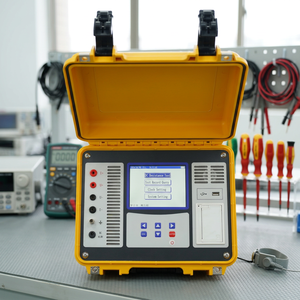
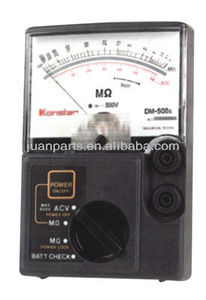
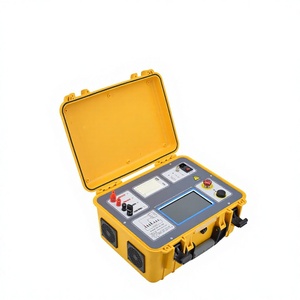
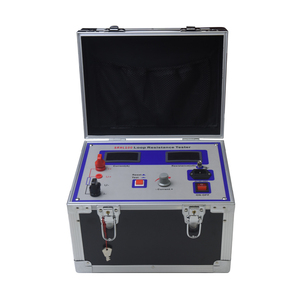
In modern electrical infrastructure, power grid maintenance, renewable energy integration, and battery manufacturing, electrical resistance testing represents a crucial diagnostic pillar. Selecting a qualified Chinese manufacturer for precision resistance meters requires evaluating metrological accuracy, long-term stability, firmware intelligence, and compliance with international standards such as IEC 60060, IEEE C57.12.90, and ISO 17025 calibration protocols.
As China's leading specialized supplier and manufacturer of electrical test instrumentation, our manufacturing eco-system integrates advanced SMT production lines, automated temperature-controlled calibration chambers, and dedicated electromagnetic compatibility (EMC) testing bays. Operating since 2003 with a global service footprint, we supply high-precision micro-ohmmeters, automated transformer DC winding resistance testers, multi-range insulation resistance diagnostic sets, and high-speed lithium-ion cell internal resistance testers to power utilities, OEM cable manufacturers, and aerospace test labs worldwide.
Core Technical Commitment: Every instrument manufactured across our China facilities undergoes multi-stage factory acceptance testing (FAT) with traceable calibration certificates. We incorporate real-time temperature compensation algorithms, Kelvin 4-wire sensing topologies, and dynamic current injection systems to eliminate contact resistance errors and thermal EMF interference.
Eliminating lead wire resistance errors down to 0.1 µΩ resolution, enabling exact measurement on low-impedance copper rods, busbars, and cable shunts.
Intuitive color GUI supporting multi-parameter data logging, automated curve plotting for polarization index (PI) and dielectric absorption ratio (DAR).
Integrated automatic fast-discharge circuits for highly inductive transformer windings, guaranteeing operator safety and rapid test cycle times.
Resistance testing encompasses diverse electrical regimes—ranging from sub-micro-ohm contact measurements on high-voltage circuit breakers to tera-ohm insulation testing on generator stators. Understanding the architectural differences between test modalities is vital for procurement engineers and facility managers.
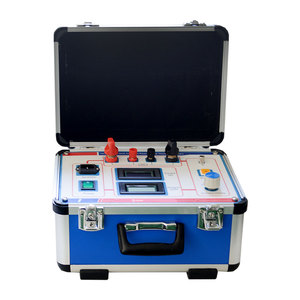
Low resistance measurement equipment (e.g., our 0.02% High-Precision DC Low Resistance Tester and HLY-301A Contact Resistance Tester) utilizes constant current source injection up to 100A or 200A DC. By forcing a stable current through a closed circuit breaker loop or cable shunt and measuring the voltage drop across potential terminals, the instrument computes resistance via Ohm's Law ($R = V/I$), effectively stripping away lead contact impedance.
Inductive loads such as power transformer windings present massive inductance ($L/R$ time constants), requiring high compliance voltage (up to 40V) to magnetize the core rapidly. Units like the Electrical Transformer Winding DC Resistance Tester (Lithium-Ion Single-Phase 10A) and HVD-850 feature dual-channel current injection, automatic thermal compensation converting measured resistance to standard $75^\circ\text{C}$ or $85^\circ\text{C}$ reference values, and demagnetization routines to prevent inrush surges upon transformer re-energization.
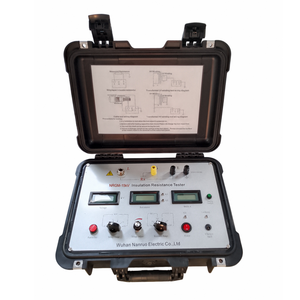
Ranging from 500V up to 15kV adjustable test outputs, systems like our Adjustable Insulation Resistance Tester evaluate insulation integrity by measuring leakage currents down to the nano-ampere level. Integrated microprocessors automatically calculate Polarization Index (PI = $R_{10\text{min}} / R_{1\text{min}}$) and Dielectric Absorption Ratio (DAR = $R_{60\text{sec}} / R_{15\text{sec}}$), revealing moisture ingress, thermal degradation, and insulation aging.
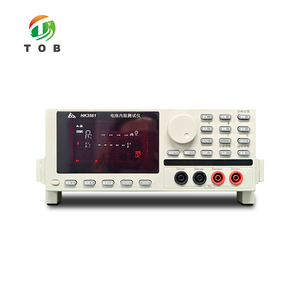
Lithium-ion cell testing requires simultaneous measurement of AC internal resistance (AC-IR at 1 kHz) and DC resistance under load. Our 20V Battery Internal Resistance Tester provides precision milliohm and microohm resolution necessary for cell sorting, grade matching, and state-of-health (SOH) evaluation in EV battery module assembly lines.
| Equipment Category | Typical Measurement Range | Accuracy / Resolution | Test Current / Voltage | Primary Industrial Application |
|---|---|---|---|---|
| Micro-Ohmmeter / Contact Tester | 0.1 µΩ to 200 Ω | ±0.02% to ±0.5% (0.1 µΩ) | 10A, 50A, 100A, 200A DC | Circuit breaker contact loop, GIS switchgear, copper busbars |
| Transformer Winding Tester | 10 µΩ to 20 kΩ | ±0.2% High Precision | 1A – 20A DC (Compliance >24V) | Substation power transformers, distribution transformers, reactors |
| HV Insulation Resistance Tester | 0.01 MΩ to 10 TΩ | ±3% to ±5% span | 0.5 kV to 15 kV Adjustable | Stator windings, HV cables, bushings, surge arresters |
| Battery Internal Resistance Tester | 1 µΩ to 3 Ω (AC-IR) | ±0.5% (1 kHz AC signal) | Up to 20V Cell Window | Li-ion pouch/cylindrical cell quality control, ESS modules |
The global market for electrical testing equipment is undergoing rapid technological shifts driven by grid modernization, renewable power generation, and mass-scale electrification. Sourcing managers and chief engineers must align their procurement strategies with these core industry trends:
Field engineers operating in remote high-voltage substations or wind farms face severe environmental challenges. Modern resistance meters have transitioned from heavy mains-only powered units to lightweight, lithium-battery-powered units enclosed in IP65-rated waterproof, dustproof impact-resistant cases. This mobility allows all-day field testing without requiring auxiliary diesel generator power.
Manual data recording is being phased out in favor of smart instruments equipped with Bluetooth, Wi-Fi, and USB interfaces. Advanced resistance testers integrate directly with substation asset management platforms and enterprise ERPs. Automated generation of test reports with environmental temperature and humidity logging ensures compliance with ISO 9001 and ISO 17025 audit trails.
Electric vehicle (EV) battery manufacturing demands extreme throughput. Next-generation battery internal resistance testers feature multi-channel multiplexing, allowing automated testing of dozens of battery cells per minute with direct PLC interface via RS485 or CAN bus protocols.
Procuring directly from established Chinese manufacturers offers substantial TCO benefits without sacrificing precision. By eliminating multiple tier-1 distributor markups, buyers obtain laboratory-grade micro-ohmmeters and transformer test sets at 40% to 60% lower capital expenditure, backed by factory-direct technical support, customizable firmware languages, and readily available spare parts.
Connect with our senior engineering team for tailored recommendations, technical specifications, wholesale OEM pricing, and regional distribution opportunities.
Get Catalog