Industrial-grade precision test equipment, high-voltage vacuum load switches, and programmable resistive/regenerative load banks engineered for global compliance labs.
Electrostatic Discharge (ESD) represents one of the most destructive fast-transient phenomena in modern electronics manufacturing, automotive sub-assembly engineering, and aerospace system design. As integrated circuit (IC) fabrication nodes shrink below 3nm and high-density power electronics operate under increasingly high voltage thresholds, electronic devices become exponentially more vulnerable to sub-nanosecond voltage spikes. A single static discharge from a human operator or automated assembly line can deliver several thousand volts within a sub-nanosecond rise time, leading to immediate semiconductor gate breakdown, latch-up, or latent micro-structural degradation.
To guarantee product reliability under real-world electromagnetic stress, international regulatory standards—principally IEC/EN 61000-4-2, ISO 10605, MIL-STD-883H, and ANSI C63.16—mandate rigorous ESD immunity testing before commercial deployment. As a premier hub for high-voltage testing instrumentation and precision electrical equipment, China's wholesale ESD simulator manufacturers and direct export factories have evolved from low-cost assembly lines into advanced research and OEM centers capable of producing state-of-the-art ESD generators, high-power dummy load banks, and vacuum circuit switching infrastructure.
This industry whitepaper explores the core physics of ESD transient generation, provides critical benchmark comparisons between air and contact discharge modalities, analyzes global supply chain sourcing strategies from leading Chinese exporters, and outlines future technology roadmaps for next-generation electromagnetic compatibility (EMC) testing infrastructure.
Precision discharge switches deliver current rise times under 0.7 to 1.0 ns into a 2-ohm calibration target, matching the exact transient waveform dynamics specified in standard IEC 61000-4-2 Edition 2.0.
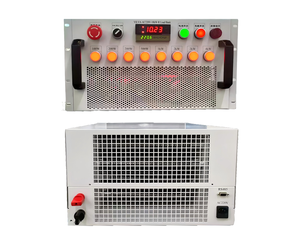
Programmable voltage ramping, automated discharge counting, dynamic polarity switching, and remote SCPI command sets facilitate seamless integration into automated test equipment (ATE) software suites.
Constructed with specialized tungsten alloys and silver-plated contact electrodes to eliminate spark erosion, guaranteeing over 500,000 discharge cycles without waveform distortion.
Achieving compliance certification requires an ESD simulator (also known as an ESD gun) to accurately reproduce the standardized discharge current waveform into a low-impedance current target (such as the standard 2-ohm ESD target mounted on a Faraday cage ground plane). The accuracy of current at 30 ns and 60 ns, peak discharge current ($I_{peak}$), and initial rise time ($t_r$) dictates whether test results are reproducible across global test laboratories.
The comparative matrix below outlines the critical parameters defined by IEC 61000-4-2 standard levels versus extended automotive requirements under ISO 10605, alongside typical OEM performance guarantees provided by top Chinese manufacturing exporters.
| Test Level | Indicated Voltage (kV) | First Peak Current ±15% (A) | Rise Time $t_r$ (ns) | Current at 30 ns ±30% (A) | Current at 60 ns ±30% (A) | Primary Target Industry |
|---|---|---|---|---|---|---|
| Level 1 | 2 kV Contact / 2 kV Air | 7.5 A | 0.7 – 1.0 ns | 4.0 A | 2.0 A | Consumer Electronics & Wearables |
| Level 2 | 4 kV Contact / 4 kV Air | 15.0 A | 0.7 – 1.0 ns | 8.0 A | 4.0 A | Medical Devices & IT Equipment |
| Level 3 | 6 kV Contact / 8 kV Air | 22.5 A | 0.7 – 1.0 ns | 12.0 A | 6.0 A | Industrial Automation & Smart Grid |
| Level 4 | 8 kV Contact / 15 kV Air | 30.0 A | 0.7 – 1.0 ns | 16.0 A | 8.0 A | Mil-Aero & Severe Environment Electronics |
| Extended Automotive | 15 kV – 30 kV Contact/Air | 56.2 A – 112.5 A | 0.7 – 1.0 ns | Variable (150pF/330pF RC) | Variable (2kΩ / 330Ω) | EV Battery Systems, ECU & Semiconductors |
Chinese direct export factories provide flexible R-C network modules (e.g., 150 pF / 330 Ω for general IEC testing; 330 pF / 2000 Ω or 330 pF / 330 Ω for automotive ISO 10605 testing). These modular plug-in networks allow procurement managers to utilize a single ESD generator chassis across multi-disciplinary testing protocols, drastically lowering capital expenditure (CapEx).
As international supply chains shift toward centralized OEM/ODM sourcing and enhanced value verification, procurement directors are altering how they evaluate high-voltage test equipment and ESD simulation systems. The global market is witnessing four distinct technology and procurement shifts:
Modern compliance facilities no longer test ESD immunity in isolation. Testing now requires devices under test (DUTs)—such as EV power converters, UPS inverters, and high-voltage vacuum switchgears—to operate under full load conditions during transient ESD discharge. Integrating 100kW+ programmable AC/DC load banks directly into EMC chambers is becoming a standard factory specification.
Traditional manual pulse logging is being replaced by automated test suites. Modern ESD simulators manufactured in China incorporate high-speed LAN/USB/GPIB interfaces, sending real-time pulse waveforms directly to digital storage oscilloscopes (DSOs) for automatic peak detection, rise-time calculation, and pass/fail report generation.
Energy conservation in burn-in rooms and test bays is driving adoption of regenerative AC load banks. Rather than dissipating hundreds of kilowatts as waste heat during extended ESD stress and aging tests, regenerative load banks feedback up to 95% of tested energy into the facility's local power grid.
Furthermore, global procurement managers are increasingly engaging in direct OEM factory sourcing. By establishing relationships directly with certified Chinese exporters, enterprises bypass regional markup structures while securing custom R-C modules, specialized test bench fixtures, and extended 3-year factory calibration warranties.
Understanding the micro-physical dynamics of static discharge is essential for accurate test configuration. ESD simulators reproduce two distinct physical mechanisms:
In contact discharge mode, the sharp metallic tip of the ESD generator is placed in direct physical contact with the conductive enclosure or ground point of the DUT before the internal high-voltage relay is triggered. This mode eliminates environmental variability (such as humidity, approach speed, and atmospheric pressure), producing a reproducible current waveform with an exceptionally fast sub-nanosecond rise time ($t_r < 1.0\text{ ns}$). Contact discharge is recognized by IEC 61000-4-2 as the primary method for quantitative compliance verification.
Air discharge simulates real-world human body interactions where a charged operator approaches an ungrounded or insulated surface. The rounded tip of the ESD gun is moved rapidly toward the DUT until an ionization arc strikes through the air gap. While air discharge closely mirrors practical environmental hazard conditions, the resulting waveform peak and rise time vary depending on approach speed, tip curvature, relative humidity, and barometric pressure. Modern China-manufactured ESD guns address this variability by incorporating ultra-stabilized high-voltage DC supplies (up to ±30 kV) and precision ergonomic housings that maintain consistent approach angles.
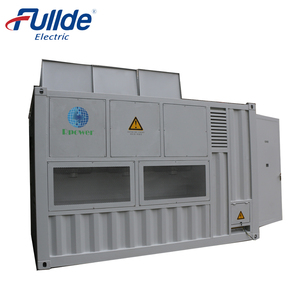
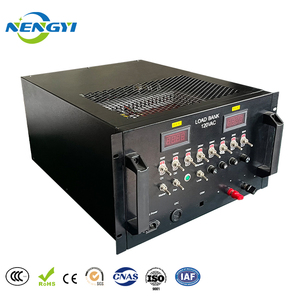
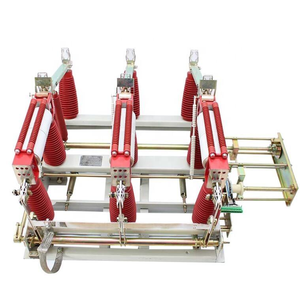
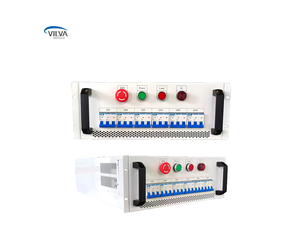
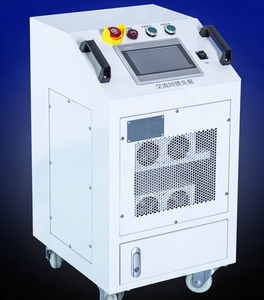
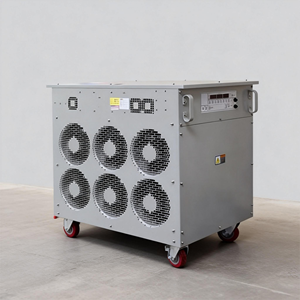
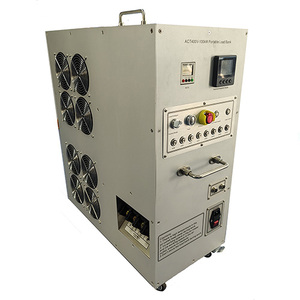
For industrial-scale infrastructure—such as smart-grid distribution sub-stations utilizing CNXE FZRN21-40.5D Outdoor High-Voltage Vacuum Load Switches or data centers employing 1000KW 3-Phase AC Load Banks—ESD and electrical fast transient (EFT) immunity must be validated under severe operational loads. High-voltage vacuum switches protect grid infrastructure during high-current fault interruptions, while heavy-duty load banks subject power distribution units to full-capacity thermal stress while ESD pulses are injected into sensitive control micro-controllers.
Leading Chinese exporters and wholesale manufacturers operate state-of-the-art production complexes equipped with automated SMT assembly lines, ISO 17025 accredited high-voltage calibration laboratories, and fully shielded EMC testing chambers. Key competitive advantages include:
Every ESD simulator and high-voltage power load bank undergoes 100% individual calibration against NIST or NIM traceable standards. Detailed calibration certificates containing oscilloscope waveform captures accompany every shipped unit.
From custom metal enclosure fabrication and transformer winding to firmware development and high-voltage potted HV modules, complete in-house manufacturing ensures strict quality control and rapid lead times.
All export products carry full CE, FCC, and RoHS certifications. Multi-lingual engineering teams provide 24/7 technical assistance, remote diagnostics, and on-site commissioning for international buyers.
Our core ESD simulator platforms cover adjustable output voltages from 0.2 kV up to ±30 kV in both contact and air discharge modes. The initial current pulse rise time ($t_r$) is strictly calibrated to 0.7 – 1.0 ns into a standard 2-ohm ESD target, fully satisfying IEC/EN 61000-4-2 Edition 2.0 and ISO 10605 automotive testing requirements.
Yes. Our portable and high-power AC/DC load banks (ranging from 1kW portable units to 1500kW industrial load systems) feature heavy-duty electromagnetic shielding and filtered communication ports (RS485, CAN, LAN). This ensures that heavy electrical loading (UPS testing, generator burn-in, EV battery discharge) can occur inside or adjacent to EMC test bays without interfering with ESD surge instrumentation.
IEC 61000-4-2 specifies a standard Human Body Model (HBM) RC network consisting of 150 pF capacitance and 330 Ω discharge resistance. Automotive ISO 10605 requires additional RC combinations (such as 330 pF / 330 Ω and 330 pF / 2000 Ω) to simulate electrostatic discharge from vehicle occupants through direct contact or air gaps into sensitive Electronic Control Units (ECUs). Our ESD guns feature modular, hot-swappable plug-in RC cartridges for rapid standard switching.
All high-voltage test instruments, vacuum load switches, and multi-kilowatt load bank cabinets are packaged in reinforced, ISPM-15 compliant sea-worthy wooden cases with shock-absorption mounts and desiccant vacuum seals. We offer door-to-door (DDP/DAP) logistics worldwide, backed by direct factory engineering support, remote software calibration, and a standard 2-year factory warranty.
Absolutely. As a direct China wholesale manufacturer and exporter, our engineering team offers full custom hardware and software design. We can tailor voltage ranges, current capacities, enclosure dimensions, cooling airflow configurations, and automation control protocols to meet your exact laboratory or production requirements.
Need customized ESD simulation solutions, high-voltage load banks, or global OEM export pricing? Contact our factory engineers today for comprehensive product datasheets, compliance consultation, and formal quotations.